The first kitchen I ever designed for a client went $23,000 over budget.
It wasn't because we chose expensive materials. It was because we chose expensive materials in the wrong places. We splurged on custom cabinet fronts that no one noticed, then ran out of money before we could upgrade the faucet, which everyone touched twelve times a day. By the time the project wrapped, my client had a kitchen that looked beautiful in photos and annoyed her every time she used it.
I've never made that mistake again.
After sixty-something kitchens, I've learned that every remodel has about five decisions that actually change how a kitchen feels to live in. Everything else is background noise. The trick isn't spending more — it's spending on the things your hands touch every day, and being ruthlessly practical about the things that just sit there looking pretty. Here's what that looks like with real numbers from Chicago projects in 2026.
Spend: The Faucet
Let's start with the hill I will die on.
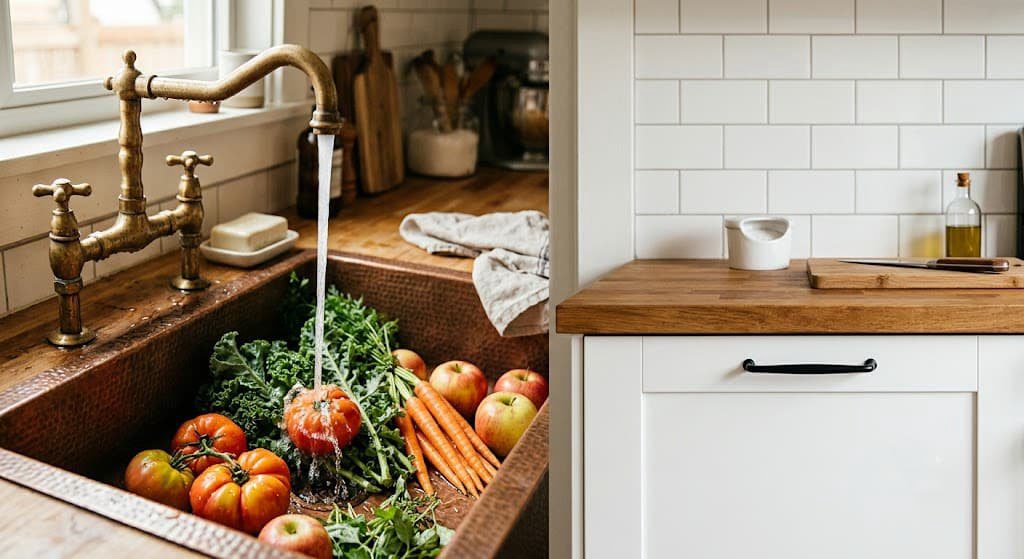
A kitchen faucet is the most physically interacted-with object in your home. You touch it with raw chicken hands, you use it to fill pasta pots that weigh fifteen pounds, you spray it, you swing it, you wipe it down forty times a week. A bad faucet announces itself constantly — stiff handle, low pressure, finish that spots up and looks grimy by Wednesday. A good faucet disappears into the background and just works.
I recommend the same faucet to almost every client: the Delta Leland pull-down in Arctic Stainless. It runs $220 to $260 depending on where you buy it. The magnetic docking actually holds the spray head in place after three years of use, which sounds like a small thing until you've lived with a faucet whose spray head dangles. The handle moves smoothly with one finger. The finish resists water spots better than faucets that cost twice as much. This is not a brand deal — Delta doesn't know I exist. I recommend it because I've specified it in forty-plus kitchens and not one client has called me to complain. In the world of kitchen remodeling, that's a miracle.
Do not spend $80 on a faucet. The internal cartridge will fail, the finish will peel, and you'll replace it in three years. If your budget is genuinely tight, save somewhere else and put the money here.
Save: The Backsplash
I need to say this carefully because backsplash tile is a genuinely fun design moment. I get it. I've stood in the Tile of Spain showroom and wanted to touch everything. But from a budget perspective, backsplash is one of the easiest places to save without anyone — including you — noticing the difference.
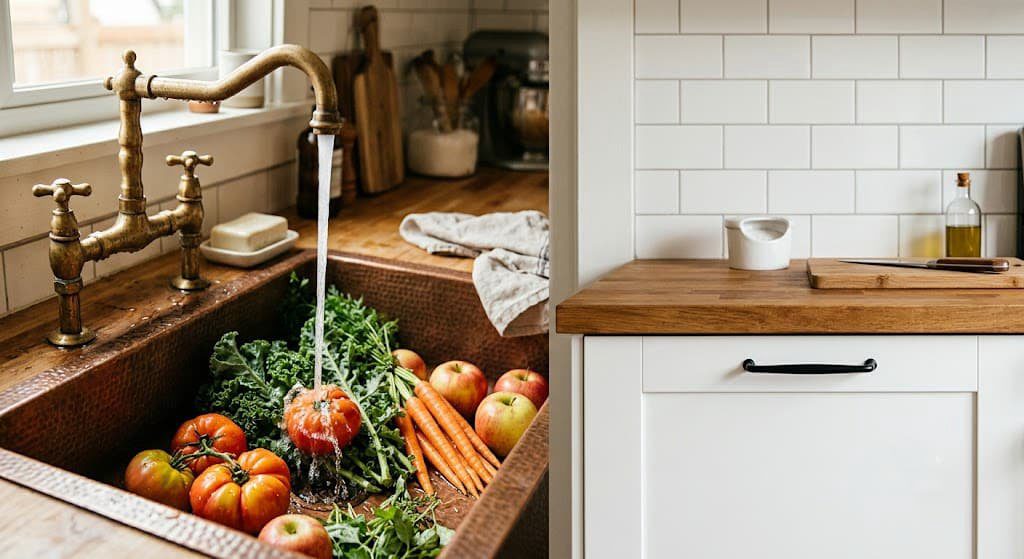
The standard white 3x6 subway tile costs about $2 per square foot at any home improvement store. It's been in style for roughly a hundred years. It's easy to clean, it reflects light, and it does its actual job — protecting the wall from water and sauce splatters — perfectly. An imported handmade zellige tile in the same shape costs $18 to $25 per square foot. It's gorgeous. I've used it in kitchens where the budget allowed. But if you're choosing between a handmade backsplash and a faucet that works, buy the subway tile and put the $900 savings into the faucet.
One exception: if your kitchen is extremely small — like a galley kitchen with eight square feet of backsplash total — the cost difference between basic and beautiful is small enough that you should get what you love. A $100 splurge on a tiny backsplash is not the place to pinch pennies.
Spend: Cabinet Hardware You Actually Touch
Cabinet hardware is another high-touch item. You open your silverware drawer six times a day. You grab the pull on the trash cabinet with wet hands. You fumble for the knob on the corner cabinet while a pan is burning.
Cheap hardware has sharp edges. The finish wears off at the contact points within a year. The screws loosen and the pulls start to wiggle. I've replaced enough builder-grade knobs in client kitchens to know that the $3-per-piece hardware is a false economy — you'll pay to replace it within two years, and the installation labor (even if it's your own Saturday afternoon) eats up whatever you saved.
Good hardware doesn't have to be expensive. I regularly specify Top Knobs and Schaub & Company pulls in the $8 to $15 range — solid zinc construction, finishes that hold up, edges that feel smooth under your fingers. For a typical kitchen with 25 to 30 pieces of hardware, that's roughly $200 to $450 total. The cheap stuff would save you maybe $150. Over ten years of daily use, that's four cents a day. Spend the four cents.
Save: Upper Cabinets (Seriously)
This one surprises people.
Custom cabinets are expensive for good reason — they're built to exact dimensions, the materials are higher quality, and the craftsmanship shows. But the cost difference between custom and semi-custom or stock cabinets is most noticeable in the upper cabinets, where the boxes are shallow and the doors are simple rectangles. A stock upper cabinet from a reputable brand like IKEA's Sektion line or a semi-custom line like KraftMaid does the exact same job as a custom upper cabinet for about 40% to 60% less money.
Where custom cabinets earn their price is in the lower cabinets — deep drawers, pull-out shelves, corner solutions, appliance garages, and anything that involves specific dimensions for how you actually store your pots and pans. If your budget has limits, put your cabinet money into the base cabinets and island, and go stock on the uppers. No one will know. Not even Jack, and he notices everything.
Spend: Drawers Instead of Lower Shelves
This is the single best money you will spend in a kitchen remodel, and I will not negotiate on it.
Lower cabinets with shelves are where kitchen tools go to die. You get on your hands and knees, you reach into the dark, you knock over the blender base trying to reach the stock pot in the back, you give up and buy another blender base. That's not a joke — I once had a client who owned three garlic presses because she couldn't see any of them.
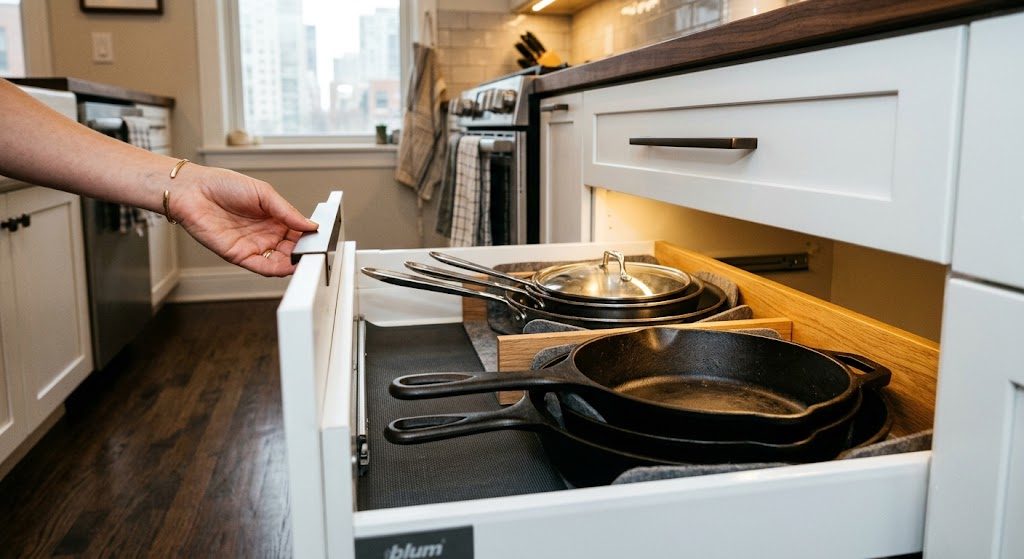
Deep drawers in your lower cabinets solve this. You pull the drawer out, you see everything in it, you grab what you need. No kneeling. No excavating. Every client who has switched from lower shelves to deep drawers has told me, unprompted, that it changed how they feel about their kitchen. The cost difference — adding drawer hardware and drawer boxes instead of a shelf and a door — is usually $1,500 to $3,000 for a full kitchen. If you have to cut something else to get this, cut something else.
Save: Trendy Appliances
The internet is full of people telling you to buy a steam oven and a warming drawer and a built-in coffee system. I'm sure those are lovely. I have never once, in eight years of designing kitchens, had a client say they regretted skipping the warming drawer. I have had multiple clients say they regret the wall of built-in appliances they never use.
Buy a good range. Buy a quiet dishwasher. Buy a fridge that fits your family's actual food habits — if you eat mostly fresh produce, you want flexible storage and humidity control; if you're a frozen-pizza-and-leftovers household, freezer organization matters more than anything else. Everything beyond range, fridge, and dishwasher is optional. You can make incredible meals with those three and a toaster.
The Budget Breakdown I Actually Use
Every kitchen project is different, but here's the rough allocation I aim for when planning a Chicago remodel in 2026, assuming a $40,000 to $80,000 project range:
Cabinetry and installation: 30% — spend on base cabinets and drawers, save on uppers
Countertops: 15% — quartz or quartzite if you can, laminate if you need to save now and replace later
Appliances: 15% — three solid workhorses, skip the luxury add-ons
Plumbing and faucet: 5% — spend here, this percentage is small but the impact is huge
Lighting: 5% — at least three layers, but fixtures don't need to be expensive (more on this in a future post)
Flooring: 10% — durability over fashion, you're going to spill on it
Labor and installation: 15% — do not DIY electrical or plumbing, I've seen what happens
Contingency: 5% — something unexpected will happen, because kitchens are full of surprises inside the walls
These percentages aren't rules. They're starting points. Your kitchen might need more in flooring if you're replacing tile in an adjacent mudroom, or less in cabinetry if you're keeping the boxes and just replacing doors and drawer fronts. The principle is what matters: assign your budget to the things you touch, and question every line item that's just there to look expensive.
This Week, Try This
Walk into your current kitchen and touch ten things on purpose. The faucet. A cabinet pull. A drawer. The edge of the counter. The floor under your feet. Notice which ones feel good and which ones grate on you.
Those grating moments are your spending priorities. Everything else is a place you can save.
A great kitchen doesn't happen by accident. It happens by how you live in it.


No comments yet — be the first to share a thought.