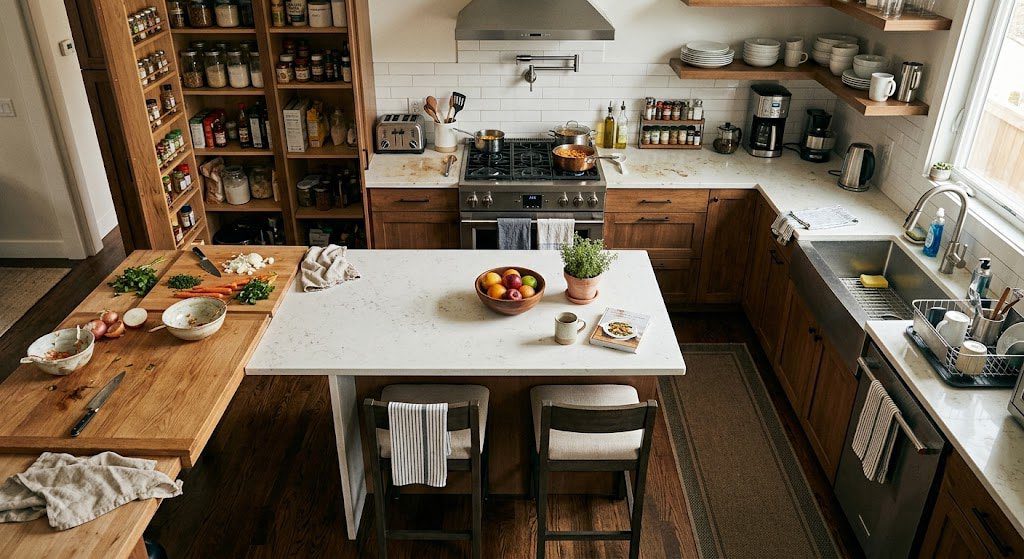
I learned the work triangle in design school. Every kitchen designer does. It's the 101-level rule that gets drilled into you on day one: the sink, refrigerator, and range should form a triangle. No leg should be shorter than 4 feet or longer than 9 feet. The total perimeter should fall between 13 and 26 feet. Obey the triangle, and your kitchen will be efficient.
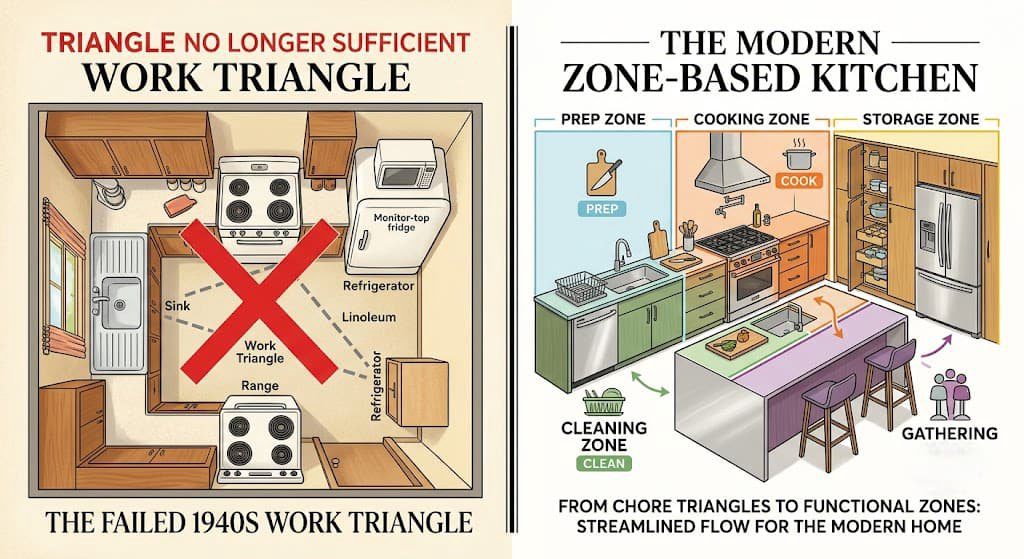
The problem? The work triangle was developed in the 1940s by the University of Illinois School of Architecture. It was based on studying how one person cooked in a small, enclosed kitchen with three appliances. There was no island. No microwave. No second cook. No kid doing homework three feet from the cutting board.
I've designed kitchens for families where two adults cook simultaneously while a child sits at the island and someone else walks through to grab a LaCroix. The triangle has nothing to say about any of that. The kitchen work triangle is an outdated design rule from the 1940s that assumes one cook in a closed kitchen — modern kitchens need a zone-based layout instead.
If you're planning a kitchen remodel today and your designer starts talking about the triangle like it's sacred, I want you to know: there's a better way.
What the Work Triangle Gets Right (Because We Should Be Fair)
Before I bury the triangle entirely, let me acknowledge why it stuck around for 70-plus years. The core idea is sound: the three points you use most in a kitchen — cooking, cleaning, and food storage — should be positioned so you're not running laps between them. That's still true. If your range and your fridge are forty feet apart, you'll hate cooking in that kitchen. The triangle was trying to solve a real problem.
But it solved it for a world that no longer exists.
The triangle assumes a closed kitchen with one entry point. It assumes one person cooking alone. It assumes three discrete workstations that don't overlap. It has zero guidance for islands, peninsula counters, wall ovens separate from cooktops, microwave drawers, beverage fridges, or the simple reality that your kitchen probably opens into your living room.
Once you add a second cook or an island, the triangle collapses. I've watched clients try to force their kitchen into a triangle shape that made no sense for their actual floor plan. They'd squeeze the sink into a corner to get the geometry right, then realize they'd created a prep zone the size of a cutting board. Forcing a kitchen into a work triangle often creates worse layouts than ignoring the rule entirely. That's not design — it's obedience to a diagram.
The Five Kitchen Work Zones That Actually Make Sense
So what replaces the triangle? Kitchen work zones. A zone-based kitchen layout groups tasks and tools by function instead of forcing three points into a geometric shape. It's flexible. It works for one cook or three. It accommodates islands, open plans, and the fact that your five-year-old wants to "help."
Here are the five zones I plan for in every kitchen I design.
Zone 1: The Prep Zone
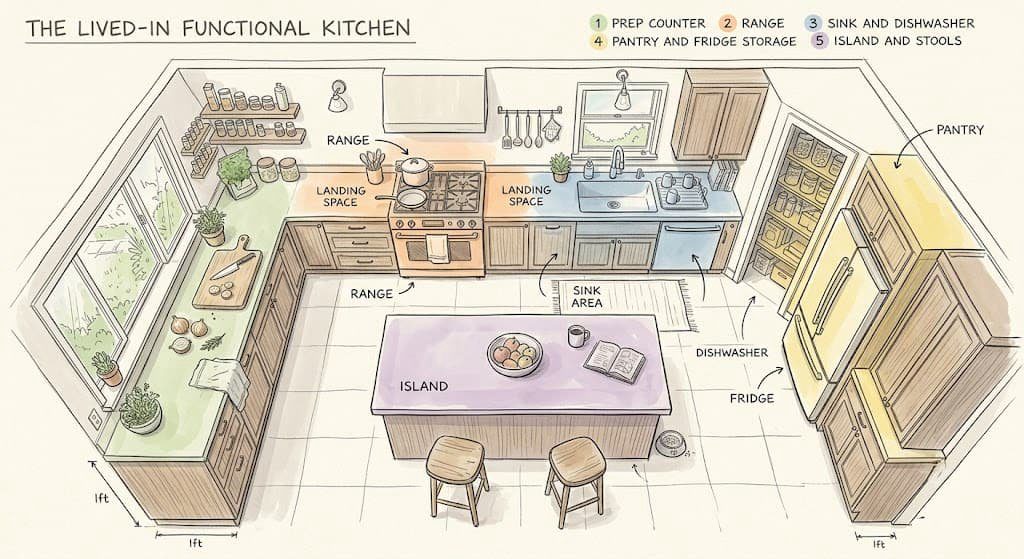
This is the most important zone in your kitchen. It's where you chop, mix, season, and assemble. It sits between your sink and your range — or between your sink and wherever you actually cook. It needs at least 36 inches of uninterrupted counter space, a trash pull-out nearby, and easy access to knives and mixing bowls. If you get one zone right, make it this one.
Zone 2: The Cooking Zone
This zone centers on your range or cooktop, but it also includes your wall oven, microwave, and toaster oven if you use one regularly. It needs landing space on at least one side — a heat-resistant surface where you can set down a hot sheet pan without thinking. Pot holders, cooking utensils, oils, and spices should live within arm's reach. In a well-zoned kitchen, you can grab a spatula and a pinch of salt without taking a single step.
Zone 3: The Cleaning Zone
Yes, this includes the sink. But it also includes the dishwasher, the compost bin, the dish soap, and the drawer where you keep dish towels and scrub brushes. If you have kids, this zone should be positioned so someone can load a plate into the dishwasher without walking through the prep zone while you're chopping onions.
Zone 4: The Storage Zone
This is your fridge, your pantry, and any cabinet where you keep dry goods, cans, and snacks. It should be near the entry point where you bring in groceries. It should not require you to walk across the kitchen and around the island to put away a box of pasta. I also include small appliance storage here — blenders, Instant Pots, stand mixers — because they need homes you can access without climbing onto the counter.
Zone 5: The Gathering Zone
This is the zone the work triangle completely ignores. It's the island seating, the breakfast nook, the counter where your kid does homework while you cook. It's not a workspace, but it interacts with the other zones constantly. A gathering zone placed wrong will put bodies in your prep path every single evening. Placed right, it lets your family be near you without being in your way.
How to Arrange Your Zones
There's no single correct zone layout — it depends on your kitchen's shape, your family's habits, and how many cooks you have. But here's the framework I use.
For a single-cook household, I arrange zones linearly: Storage → Prep → Cooking → Cleaning, with the Gathering zone offset so it doesn't intersect the main workflow. Think of it as a gentle curve through the kitchen, not a triangle.
For a two-cook household, I make sure there are two distinct prep areas, or at least a long enough prep zone that two people can work side by side without elbowing each other. I also check that the Cleaning zone can be accessed without crossing the Cooking zone — because one person washing dishes while the other is sautéing should not require a choreographed dance.
The Island Question
Islands are the number-one reason the work triangle fails. A well-placed island can serve as a prep zone, a cooking zone (with a cooktop), a cleaning zone (with a sink), or a gathering zone (with seating). But it can't be all four at once.
The mistake I see most often: an island that tries to do everything and ends up doing nothing well. It's got a sink, so it's a cleaning zone — but it's also the only spot for stool seating, so it's a gathering zone — and it's between the fridge and the range, so it's in the prep path. The result is a kitchen where every zone collides in a 3-by-6-foot rectangle.
Pick your island's primary job. If it's prep, skip the sink and keep the surface clear. If it's gathering, put it outside the workflow. If you want a second sink, own that it creates a second Cleaning zone — and plan the rest of the kitchen accordingly. An island should serve one primary zone function, not try to be all of them at once — that's how kitchens become chaotic. (精选摘要候选)
This Week, Try This
Draw a rough sketch of your current kitchen. Don't measure — just roughly block out where things are. Then, with a highlighter, mark where you actually do each task. Where do you chop? Where do you set down groceries? Where does your partner stand when they're "just grabbing something" while you cook? Where does your kid linger?
You'll probably find that your kitchen already has zones — they might just not be the ones your floor plan intended. That's useful information. A kitchen that works is one where the zones match how you actually live.
The triangle was a good rule for 1945. Your kitchen deserves a design that's as alive as the people cooking in it.
A great kitchen doesn't happen by accident. It happens by how you live in it.

No comments yet — be the first to share a thought.