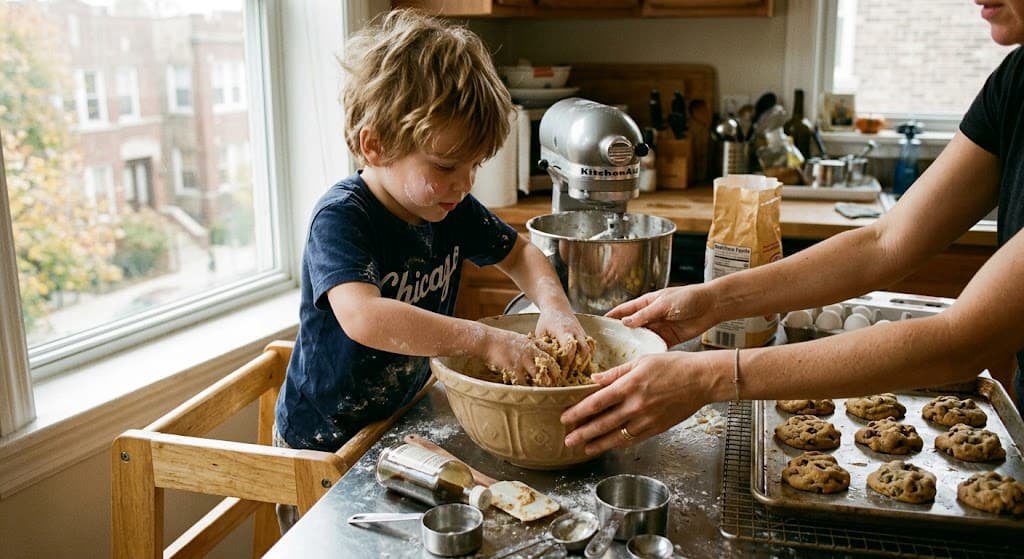
Three Saturdays ago, Henry and I attempted chocolate chip cookies. He's five. He can crack an egg now, which he treats like defusing a bomb — total focus, tongue poking out of the corner of his mouth, both hands moving in slow motion. The egg went in. So did about a tablespoon of shell.
We fished out what we could find. I told him shell adds calcium. He believed me. We baked the cookies anyway, and they were — I'm being honest here — crunchy in a way chocolate chip cookies are not supposed to be. Henry ate three of them and announced they were the best cookies he'd ever had. Then he asked if we could make them again next Saturday.
This is what weekend baking looks like in my kitchen. It's not the photos you see on food blogs. There's no marble countertop, no styled flat-lay of ingredients in tiny glass bowls. There's a five-year-old in pajamas, a stand mixer I bought secondhand, and a roughly 50% success rate. I've learned more from the failures than the wins, and I've learned even more about what actually keeps the experience fun for both of us.
Lower the Stakes Before You Start
The first few times Henry and I baked together, I had an outcome in mind. I wanted the cookies to look like the recipe photo. I wanted him to follow the steps in order. I wanted the kitchen to not look like a bag of flour had exploded.
None of that happened. I got frustrated. He sensed it and got quiet. We ended up with perfectly round cookies and a kid who didn't want to bake with me for two weeks.
The shift came when I stopped treating baking as a project with a deliverable and started treating it as an activity where the process was the whole point. This sounds obvious. It's much harder to actually do when you're standing in your own kitchen with flour drifting onto the floor and your coffee getting cold on the other counter.
What worked for me: I pick recipes where the outcome genuinely doesn't matter. Pancakes are forgiving. Muffins are forgiving. Cookies are forgiving if you catch them before they burn. I do not attempt laminated pastry with a child. I do not attempt anything that requires tempering chocolate. The recipe is a suggestion, not a contract. If Henry wants to add twice the vanilla because he likes the smell, we add twice the vanilla. The pancakes might taste like a candle. That's fine. That's data for next time.
The Tools That Actually Help
I've accumulated a few pieces of kid-friendly kitchen equipment that make a real difference. None of them are marketed as "kid-friendly." Most of that stuff is plastic and flimsy and frustrating to use. Kids know when they're being handed the toy version of something.
A stable step stool. This is not optional. Henry uses the IKEA Bekväm stool, which is solid beech, wide enough that he can shift his weight without tipping, and low enough that he can drag it to the counter himself. I've seen him push it across the kitchen floor like a sled. It's held up for three years. Do not buy the folding plastic kind that wobbles when a child breathes on it.
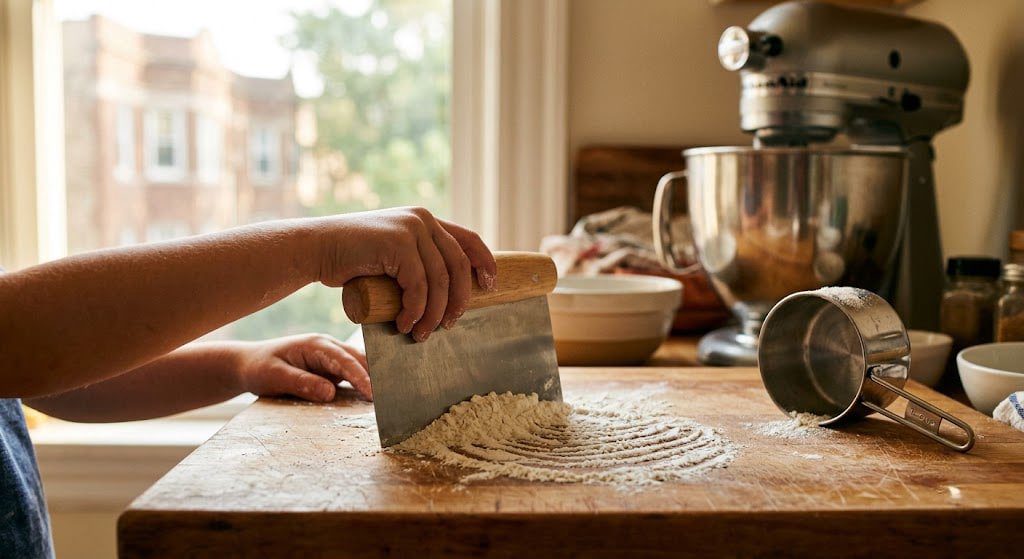
A bench scraper. Henry cannot manipulate a chef's knife safely yet, but a bench scraper — that flat metal rectangle with a wooden handle — gives him something to push chopped ingredients around the board with. He scoops flour, scrapes dough off the counter, and transfers diced butter into the mixer bowl. It costs about $8 and he uses it constantly.
A small whisk and a small spatula. Most kitchen tools are sized for adult hands. A small whisk and a short-handled spatula let Henry mix and scrape without the tool being longer than his entire arm. I found a mini whisk and spatula set at a Chicago estate sale for $2. They're from the 1970s and they're perfect.
The stand mixer. I bought a refurbished KitchenAid Artisan five years ago, before Henry was born. Watching him learn to use the speed lever — push it up to make it go fast, push it down to stop — has been one of the most satisfying things I've watched in this kitchen. He treats that mixer like he's piloting a spaceship.
Timing Matters More Than You Think
I learned this one the hard way. Do not start a baking project with a five-year-old at 4:30 PM when everyone is hungry and dinner hasn't been thought about yet. Do not start it when you're rushing to get somewhere. Do not start it when you're already tired.
Saturday morning, after breakfast but before the day's momentum has built up — that's our window. Henry is fed. I'm caffeinated. There's nowhere to be. If the cookies take forty minutes or an hour and a half, it doesn't matter.
The other timing lesson: know which steps are kid steps and which are adult steps. Henry can measure, pour, mix, scoop, and roll. He cannot handle a hot oven, read a recipe, or judge whether butter is "softened" or just melted. I prep the adult steps beforehand — measure nothing, just get the butter to room temperature, pull the eggs out, set the oven. Then when he's ready to start, we move through his steps without stopping to wait for me.
What to Do With the Mess (And the Feelings)
The mess is going to happen. Flour on the floor, egg on the counter, batter crusting on the stove because we made pancakes three hours ago and I still haven't wiped it up. I've made partial peace with this.
What helped: I keep a damp dishcloth on the counter during the entire project. Henry wipes his hands on it instead of his shirt. I wipe down the counter as we go, not after. It takes ten seconds between steps and it keeps the chaos from reaching a point where I get visibly annoyed, which Henry notices.
There's also the emotional mess, which I didn't anticipate. Sometimes Henry gets frustrated because the dough is too sticky on his hands. Sometimes I get short with him because he's stirring and half the batter is leaving the bowl. Sometimes a recipe fails and he's disappointed and I'm disappointed and we're both standing there looking at a tray of burnt cookies.
I've learned to name the feeling out loud. "That's frustrating, huh? The dough is really sticky." That's it. I don't try to fix it or tell him it's fine or promise the next batch will be better. I just acknowledge it. He usually moves on in about fifteen seconds. Sometimes I'm the one who needs the fifteen seconds.
The Recipes That Survive Our Kitchen
After a year of weekend baking, here's what we return to.
Saturday morning pancakes. The Joy of Cooking buttermilk pancake recipe, with one modification: Henry adds chocolate chips to his and blueberries to mine, and we make shapes on the griddle. Hearts, dinosaurs, something vaguely circular. The dinosaur ones always look like blobs. We call them dinosaur blobs and eat them anyway.
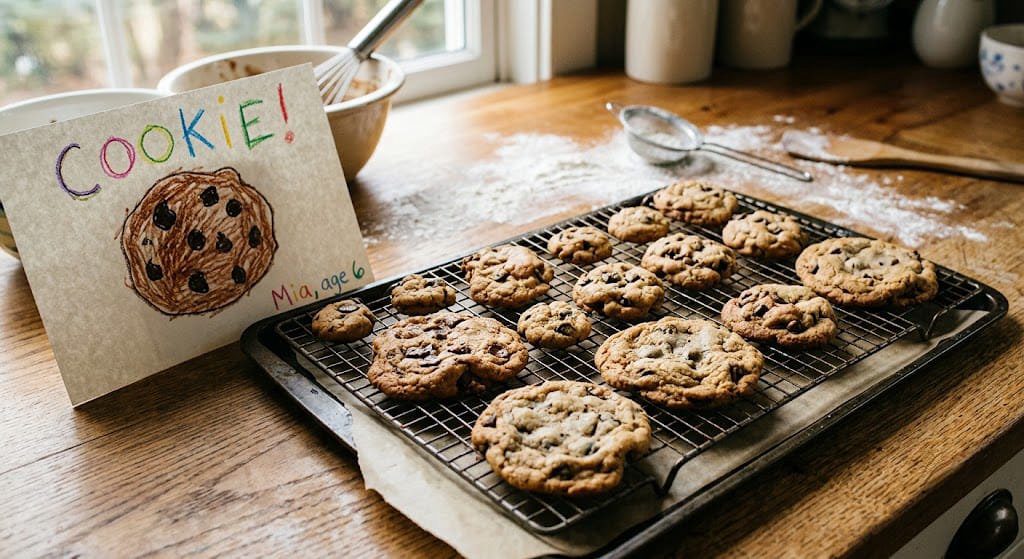
Drop cookies. Any recipe where you scoop and drop rather than roll and cut. Chocolate chip, oatmeal raisin, peanut butter. Henry's job is scooping the dough onto the baking sheet. Some cookies are enormous. Some are tiny. He calls the tiny ones "baby cookies" and the big ones "daddy cookies." I have no idea what this says about Jack.
Quick breads. Banana bread, zucchini bread, pumpkin bread. These are Henry's favorite because he gets to mash the bananas with a fork, which is apparently the most satisfying task in the history of cooking. The bench scraper also gets heavy use cutting quick bread into slices, which means he hacks at it enthusiastically and we end up with pieces of wildly varying thickness. It tastes the same.
The Part I Didn't Expect
Here's what no one told me about baking with a kid. It's not about teaching him to cook. It's not about life skills or math or fine motor development, though all of those things are happening in the background.
It's that Saturday mornings in this kitchen have become the time when Henry tells me things. Standing at the counter with flour on his hands, not making eye contact because he's focused on the dough, he tells me about his week. About a kid at preschool who wouldn't share the blocks. About a dream he had. About a question he's been carrying around about whether squirrels get cold in the winter.
The baking is the excuse. The baking is what gives his hands something to do so his mind can wander where it needs to go. I didn't plan this. It happened because we were standing next to each other long enough, doing something repetitive, with no agenda except pancakes.
That's the part I'd hold onto even if every single recipe failed.
This Week, Try This
If you've got a young kid and a free morning this weekend, pick something simple to make together. Pancakes, muffins, a boxed mix — the recipe doesn't matter. Lower the stakes all the way to the floor. Tell yourself the goal is the mess, not the food.
Then watch what your kid does when there's no pressure and no hurry and you're both just standing there with flour on your hands.
A great kitchen doesn't happen by accident. It happens by how you live in it.


No comments yet — be the first to share a thought.