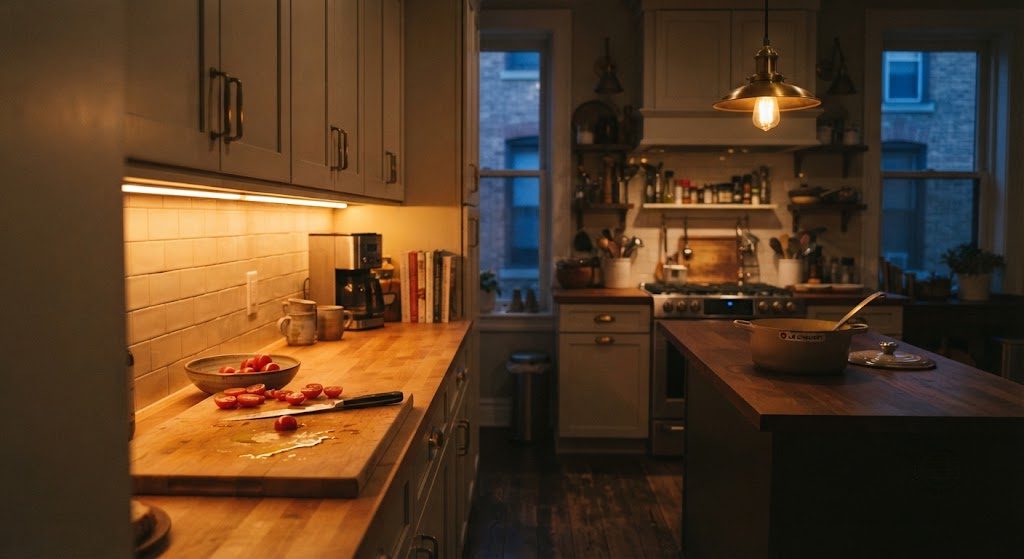
I've walked into beautiful kitchens that felt terrible to cook in. Expensive countertops, custom cabinets, a range that cost more than my first car — and one light fixture in the center of the ceiling, throwing shadows on every work surface.
This is the most common lighting mistake I saw across sixty-something kitchen remodels: treating the kitchen like one room with one light. It's not. A kitchen is a workshop, a dining room, a gathering space. Each function needs different light.
A single ceiling fixture casts light downward. When you stand at the counter, your body blocks that light and throws a shadow onto the exact spot where you're chopping. The corners go dark. The whole kitchen feels smaller than it is. A brighter bulb doesn't fix this — it just makes the shadows harsher.
The fix is layers. Good kitchen lighting has three layers: task lighting for work surfaces, ambient lighting for overall illumination, and accent lighting for depth and warmth. Skip any layer, and something feels off even if you can't name why.
Layer One: Task Lighting
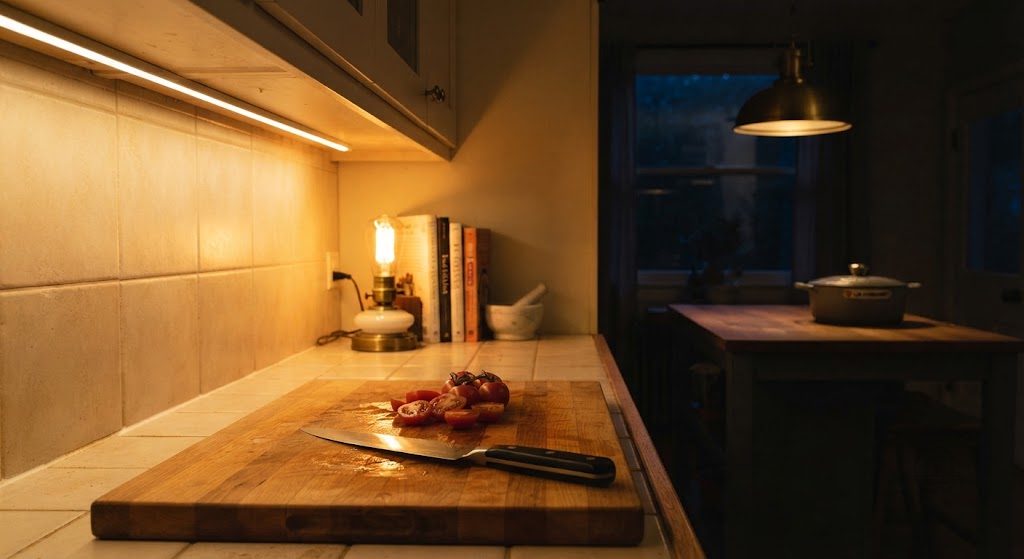
Task lighting puts light directly on your work surfaces — the counter, the sink, the stove. Under-cabinet lighting is the best place to start. It mounts to the underside of upper cabinets and shines directly onto the counter below. No shadows. No squinting at a recipe.
Options for every budget: hardwired LED strips require an electrician but disappear into the cabinet design. Plug-in LED bars cost $25 to $50 and stick on with adhesive. Battery-powered puck lights cost even less and install in five minutes. They're not as bright, but they're better than nothing. Henry calls them "kitchen nightlights."
If you do nothing else, add under-cabinet lights. It's the single highest-impact lighting change you can make.
Layer Two: Ambient Lighting
Ambient lighting is the general illumination that fills the room. It's the ceiling fixture you already have — but it shouldn't be the only thing.
The mistake I see most: ambient lighting that's too cool. A 4000K or 5000K bulb gives off harsh, bluish light that makes food look unappetizing. Choose warm white bulbs — 2700K to 3000K — for kitchen lighting that feels welcoming. Save the cool light for the garage.
If you're remodeling and adding recessed lights, position them directly over the edge of the counter so the light falls on the work surface, not behind you. This is the detail that separates kitchens designed by someone who cooks from kitchens designed by someone who only looks at floor plans.
Layer Three: Accent Lighting
Accent lighting is the layer people skip because it feels decorative. But it serves a real purpose — adding depth and warmth after dark.
A small lamp on the counter. LED strips inside glass-front cabinets. Toe-kick lighting along the floor. These lights don't need to be bright. They just need to exist. I have a small vintage lamp on the corner of my counter, an $8 estate sale find with a slightly crooked shade. It's not for cooking. It's for the hour after dinner when the kitchen is clean and the main lights are off and the lamp makes the whole room feel like it's exhaling.
The One Mistake
One switch. One circuit. Every light goes on and off together.
This undoes all the layering. Task, ambient, and accent lights need separate switches or dimmers so you can control them independently. Bright task light for chopping. Softer light for eating and lingering. If everything is on one switch, you'll leave the harsh lights on all the time because turning them off means turning everything off. Separate controls let the kitchen change moods.
Start Here
Add one layer this week. Under-cabinet lights if you have none. A warmer bulb in the overhead fixture if the current one is too cool. A small lamp on a corner of the counter if you want to see what accent light does. One change, not three. The kitchen will feel different immediately — brighter where it matters, softer where it counts.
A great kitchen doesn't happen by accident. It happens by how you live in it.
No comments yet — be the first to share a thought.