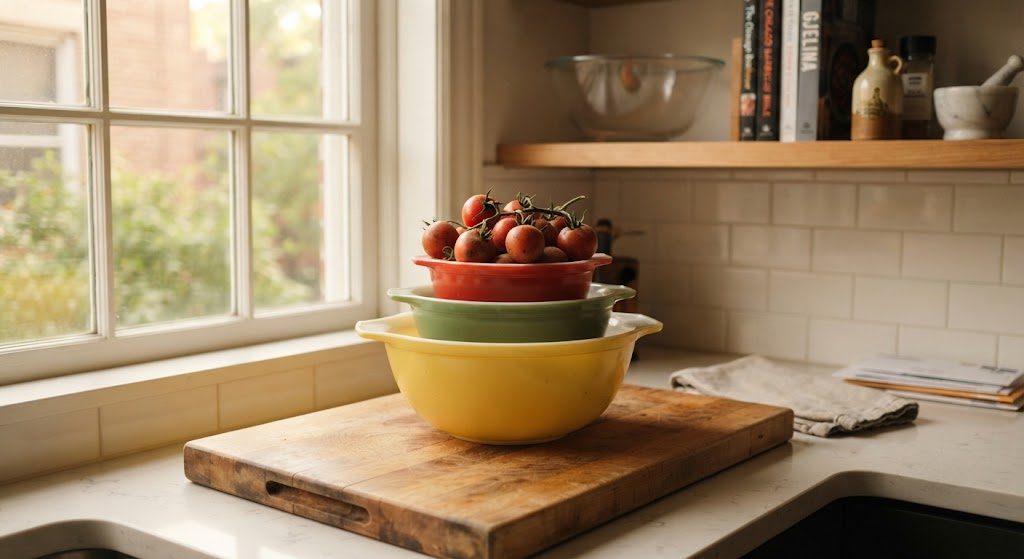
I bought my first vintage Pyrex bowl at an estate sale in Logan Square six years ago. It was a primary yellow mixing bowl, the 4-cup size, with a few faint scratches on the inside and a price tag of $4. I didn't know anything about Pyrex patterns or borosilicate glass. I just thought it was pretty.
I still use that bowl every week. It's held pancake batter on Saturday mornings, cherry tomatoes from the garden, and the failed cookie dough Henry and I made last month. It's been dropped on the tile floor from counter height and bounced. The modern glass mixing bowl I got as a wedding gift sits unused on a high shelf.
Not all vintage Pyrex is created equal. Some patterns are worth hunting down. Some are pretty but impractical. Some should stay on the thrift store shelf no matter how charming they look.
The Pyrex That Actually Holds Up
The vintage Pyrex worth buying is the stuff made before the formula changed. Vintage Pyrex mixing bowls made before the 1980s were borosilicate glass, which resists thermal shock — modern Pyrex is soda-lime glass, which is more prone to shattering under extreme temperature changes. If you're going to actually use your Pyrex rather than display it, the borosilicate era is what you want.
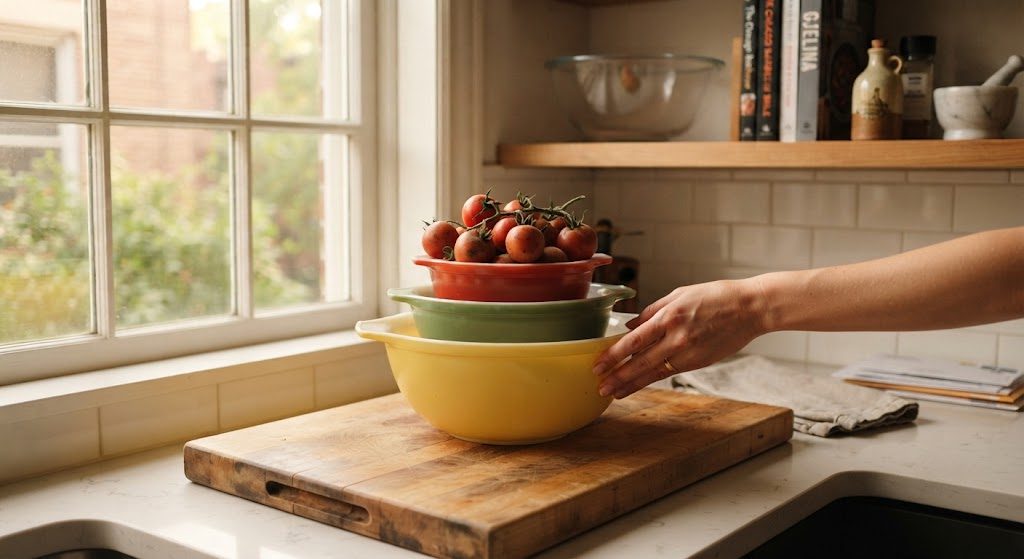
The easiest way to spot borosilicate Pyrex: the primary color mixing bowl sets from the 1940s and 1950s. Red, yellow, green, blue — one bowl nested inside the next, the largest holding 4 quarts. The glass is thicker than modern Pyrex. The colors are saturated and even. The rims are smooth from decades of use but the bowls themselves are nearly indestructible.
I have a full set of four that I found across three different estate sales over two years. Total cost was about $35. A new set of modern Pyrex mixing bowls costs roughly the same and will not survive a drop onto tile. Ask me how I know.
The milk glass Pyrex from the same era — white bowls with opaque white exteriors — are also borosilicate and equally durable. They're harder to find but worth grabbing if you see them. The white finish hides scratches better than the colored bowls.
Patterns That Are Worth Picking Up
If you're hunting estate sales for Pyrex, here's what to look for.
Primary Colors (1940s-1950s). The red, yellow, green, and blue nesting bowls. These are the most common vintage Pyrex find and the most useful. Buy them to use. The 4-cup yellow bowl is the most useful size in a home kitchen — big enough for pancake batter, small enough to handle with one hand.
Butterprint (1950s-1960s). White bowls with a turquoise print of Amish farm scenes — wheat sheaves, roosters, farm couples. This is one of the most collected patterns, which means prices are higher than they should be. A complete Butterprint Cinderella bowl set with lids can run $80 to $150 at antique stores. At estate sales, you can still find them for $15 to $30 if you're early and the seller doesn't know what they have.
Spring Blossom / Crazy Daisy (1970s-1980s). Green floral daisies on white milk glass. This pattern was produced for over a decade and is everywhere at thrift stores. Prices are low — $5 to $10 a piece — and the milk glass base is durable. It's not the most valuable pattern, but it's the easiest to find and perfectly functional.
Town and Country (1960s). A warm brown and gold wheat pattern on white. Less collected than Butterprint, which means better prices for a pattern that looks beautiful on a Thanksgiving table. Casserole dishes in this pattern are especially good finds.
What to Skip
Some vintage Pyrex looks great on a shelf and falls apart in a kitchen.
Anything with gold leaf or metallic trim. The gold wears off in the dishwasher, which means you're hand-washing forever, and even then it fades. These were display pieces, not workhorses. If you want a bowl to use, skip the gold.
Patterns from the 1980s onward. By this point, Pyrex had switched to soda-lime glass. The patterns are often earth-toned and dated in a way that's not charming, and the glass doesn't have the thermal durability of the older stuff. You can use these for mixing and serving, but don't pour boiling water into them.
Pieces with deep scratches or chips on the rim. A chip is a weak point. Thermal shock will find it. A scratched interior is less of a functional problem but harder to clean. Light scratches are fine — the bowl has lived a life. Deep gouges mean the glass is compromised.
Patterns you don't actually like. This sounds obvious, but collecting Pyrex is seductive. You find a piece at a good price, the pattern is rare, and suddenly you own a pink gooseberry casserole dish you'll never use. Buy what you'll cook with. Your kitchen is not a museum.
How I Actually Use Mine
The yellow primary bowl lives on the counter during tomato season, holding whatever I just picked. The green bowl is for pancake batter on Saturdays with Henry. The red bowl only comes out for holidays — it holds mashed potatoes at Thanksgiving and looks like it was made for exactly that purpose.
The Butterprint Cinderella bowl set sits on an open shelf where I can see the pattern, but I pull the smallest one down for mixing salad dressing or whisking eggs. They're beautiful and functional. That's the whole point.
If you find a stack of primary Pyrex bowls at an estate sale for under $20, buy them. You'll use them more than any modern mixing bowl you own.
A great kitchen doesn't happen by accident. It happens by how you live in it.
No comments yet — be the first to share a thought.