Last Tuesday, Henry used our kitchen faucet to fill a mixing bowl, rinse a paintbrush, and spray pancake batter across the backsplash. I was annoyed for about ten seconds, then grateful for the high arc and flexible hose that let me clean the mess without crawling under the cabinet. That is the real test for the best kitchen faucets: not how polished they look in a showroom, but how they behave during dinner, dishes, and the occasional household science experiment.
After specifying dozens of kitchens and living with several faucets in my own Chicago home, I look for four things first: useful reach, simple controls, dependable construction, and a finish that does not demand constant polishing. A faucet can be beautiful and still be frustrating if the spray head barely reaches the sink corners or the handle bumps into the backsplash.
Start With Your Sink and Countertop
Before comparing styles, measure the sink and inspect the existing holes. Most single-handle faucets fit a one-hole opening, while some models include a deck plate for covering three-hole configurations. That plate is handy during a refresh, especially if you are replacing an older two-handle faucet without changing the countertop.
Reach matters more than many homeowners expect. A spout with a reach around 8 to 9 inches usually covers a standard single-bowl sink well, but an extra-deep farmhouse sink may benefit from 9 to 10 inches. Check the faucet’s height against a window, shelf, or cabinet. I once specified a handsome 16-inch model beneath a low shelf, and the client discovered that the spray head could not be removed comfortably. The faucet itself was fine; the combination was wrong.
For the best kitchen faucets, also look at the mounting surface. A thick stone countertop can require a longer supply line or mounting shank. If the sink is undermounted, installation is usually straightforward, but access beneath the basin can still be tight. Take a photo under the sink before shopping. It helps a plumber or hardware associate spot problems early.

Pull-Down, Pull-Out, or Side Sprayer?
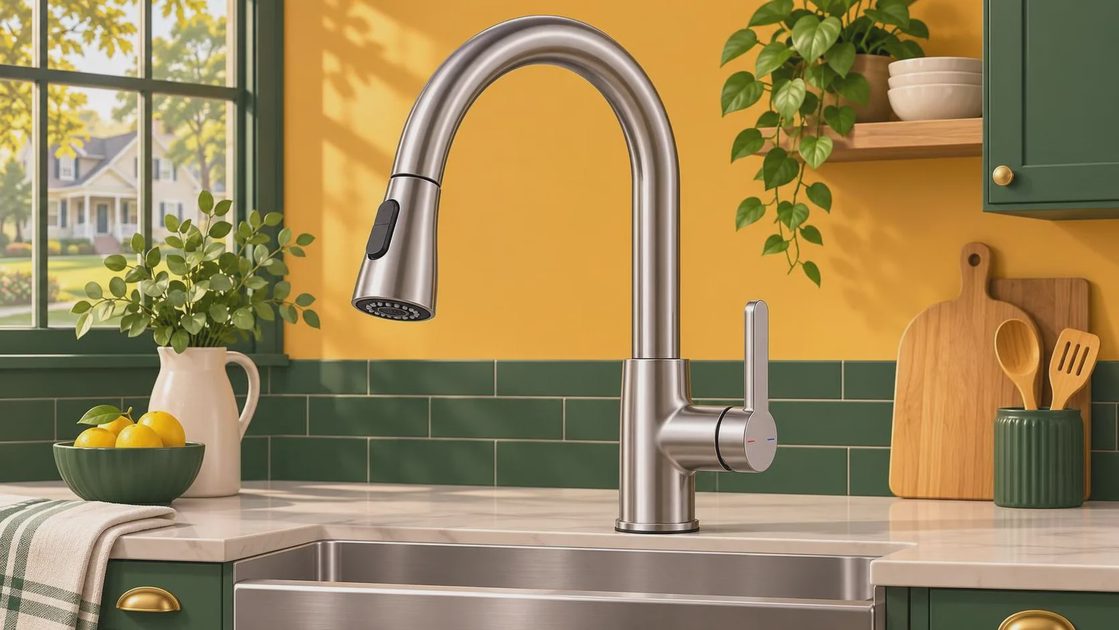
Pull-down faucets are the default choice for many modern kitchens because the spray head drops directly into the sink. They are especially useful for rinsing stockpots, washing leafy greens, and directing water at stuck-on oatmeal. A magnetic or weighted docking system keeps the head seated. When comparing the best kitchen faucets, tug the head gently in a showroom or read installation reviews to see whether docking remains secure after regular use.
Pull-out faucets have a shorter, more horizontal hose. They can be comfortable in a compact kitchen where a tall pull-down would feel oversized. The hose often gives you good control for filling a coffee maker or rinsing a small pan on the counter. They are less dramatic visually, which can be an advantage in a narrow galley kitchen.
A separate side sprayer is still a sensible option, particularly for a traditional kitchen or a sink with multiple existing holes. The sprayer can feel lighter in the hand, and its hose does not pull through the main faucet body. You lose some counter simplicity, but you gain a familiar, easy-to-replace component. Function should lead the decision, not the trend cycle.
Features Worth Paying For
A pause button on the spray head is one of my favorite practical features. It lets you stop the flow while moving a colander, which saves water and prevents the familiar splash across your shirt. A strong toggle between stream and spray is also more useful than a dozen specialty settings that nobody remembers how to activate.
Touch or touchless activation can be wonderful when your hands are covered in raw chicken or garden soil. Delta Touch2O and Moen’s MotionSense options are well-known examples of this category. They require batteries or a power source, so leave room beneath the sink and make sure the sensor location makes sense for your habits. A touchless faucet is not automatically better if Henry can trigger it every time he reaches for a cup.
For the best kitchen faucets, ceramic disc cartridges are a worthwhile construction detail. They are designed to control water with two durable ceramic discs and generally offer smooth operation over years of use. Look for a removable aerator, too. Hard-water deposits eventually collect there, and being able to unscrew the part makes cleaning far less irritating.
Materials, Finishes, and Everyday Maintenance
Stainless steel, chrome, matte black, and brushed gold all have a place in a kitchen. Chrome is often affordable and easy to match with existing fixtures, but it shows water spots. Matte black hides some marks while showing mineral residue as a pale film. Brushed finishes are forgiving because their texture disguises small scratches and fingerprints.
Do not assume that a heavy-looking faucet is automatically made entirely from solid brass. Many quality faucets combine brass, stainless steel, and engineered components. What matters is a reputable valve, secure mounting, smooth handle movement, and accessible replacement parts. Brands such as Kohler, Moen, Delta, Pfister, and American Standard offer broad product ranges, from practical entry-level models to more decorative options.
Clean the faucet with mild dish soap and a soft cloth. Avoid abrasive powder and harsh scouring pads, which can dull a finish. For mineral buildup, a cloth lightly dampened with diluted vinegar can help, but follow the manufacturer’s care instructions, especially on special finishes. In our house, wiping the spray face once a week prevents the uneven stream that signals clogged nozzles.
What Should You Spend?
A basic faucet from a home improvement store may cost roughly $70 to $150, while a dependable midrange model often lands between $150 and $350. Designer finishes, electronic controls, commercial-style coils, and premium installation details can push the price to $500 or more. The best kitchen faucets are not necessarily the most expensive ones; they are the models that match the sink, the user, and the maintenance reality.
For a busy family, I would spend first on the cartridge, docking system, and hose reach. I would spend less on a trendy finish if the budget is tight. A $180 faucet with a reliable pull-down head will improve daily life more than a $700 model that looks perfect but has an awkward handle placement.
Installation commonly adds about $150 to $350 for a straightforward replacement, although tight access, corroded shutoff valves, or countertop changes can raise the labor. If you are replacing a faucet during a larger remodel, have the installer confirm supply-line length and shutoff condition before the countertop is sealed.
My Buying Checklist
Start by measuring the sink, counter thickness, backsplash, and available cabinet clearance. Then decide whether you prefer pull-down, pull-out, or side-sprayer control. Confirm the faucet’s reach and height rather than judging from a product photo. Check whether the package includes a deck plate, supply lines, weight, and batteries if needed.
Next, read the warranty in practical terms. A limited lifetime warranty often covers the faucet body and finish for the original purchaser, while electronic parts or normal wear can have different coverage. Replacement cartridges and spray heads should be available without an elaborate service call.
Finally, stand at the sink and imagine your actual routine. Can you fill the tallest pot? Can a child turn the handle without flooding the counter? Can you clean the spray head and reach the shutoff valves? Those answers matter more than whether a faucet is currently popular on a remodeling board.
The best kitchen faucets disappear into a good routine. They make rinsing faster, filling pots easier, and cleanup less theatrical. Choose the model that fits your sink and your hands, not just your cabinet color. A great kitchen does not happen by accident. It happens by how you live in it.



No comments yet — be the first to share a thought.