I’ve walked into more kitchens than I’ve cooked in.
That’s not an exaggeration. Eight years as a kitchen designer in Chicago, sixty-something projects from demolition day to final walk-through. I’ve stood in gutted rooms with homeowners who just spent six figures on a renovation and watched their faces fall as they realized something wasn’t right. The island was too big. The fridge sat in the wrong spot. The layout looked beautiful on paper and felt terrible to actually cook in.
Almost every time, the problem began in the same place. The sink.
The Sink Trap
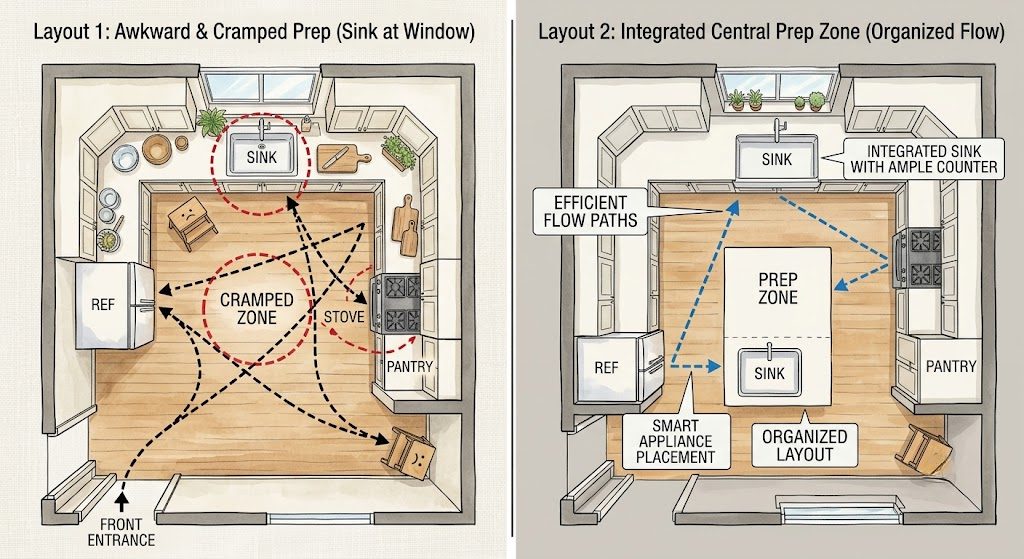
Here’s how most kitchen remodels begin. Someone stands in their existing kitchen, looks around, and thinks: I hate where the sink is. I want it under the window. So they put the sink under the window. Then they build the rest of the kitchen around that one decision. Cabinets follow. The island gets placed wherever it fits after the sink is locked in. Appliances land where there’s room left over. The whole layout orbits a single fixture that you spend maybe 15% of your cooking time actually using.
I get it. A sink under a window is lovely. You can watch the kids in the yard or stare at something green while scrubbing a pan. But when the sink becomes the sun your entire kitchen revolves around, the kitchen stops being a place where cooking makes sense. Starting a kitchen design by placing the sink is the single most common layout mistake I see — it ignores the flow of actual cooking. (This is a featured snippet candidate: a concise, direct answer to the question “What is the biggest kitchen layout mistake?”)
What I’ve seen across dozens of projects — from $15,000 IKEA hacks to $150,000 gut renovations — is that the kitchens that actually work are designed around something else entirely.
Start With How You Cook
Not how you want to cook. Not how the version of you who hosts dinner parties every weekend cooks. How you actually cook on a Tuesday night when a five-year-old is using the step stool to “help” stir the sauce and half of it lands on the stove.
For most of us, cooking follows a rhythm. You pull things from the fridge. You move to a prep surface. You chop, season, cook at the range, and plate. Somewhere in there you’re dodging a spouse refilling a water glass and a kid grabbing a cheese stick. That rhythm — the actual path your body takes through the kitchen a hundred times a night — is what your layout should serve.
So instead of starting with the sink, I start every design by asking three questions.
One: What’s Your Prep Zone?
Where do you actually chop, mix, and season? For most home cooks, the stretch of counter between sink and range is the hardest-working real estate in the kitchen. If that space is cramped, broken up by a corner, or positioned somewhere inconvenient, cooking feels harder than it should. In a well-designed kitchen, the prep zone is generous — I recommend at least 36 inches of uninterrupted counter — and positioned so you can pivot from fridge to prep to range without walking a marathon.
Two: What’s the First Thing You Do When You Walk In?
For my family, it’s drop the groceries. If the fridge is twenty feet from the door we actually use, that’s a design problem. If the pantry is buried behind the dining table, we’re going to leave non-perishables on the counter for three days because putting them away is a hassle. Your kitchen has entry points beyond the main doorway, and they matter more than most floor plans acknowledge.
Three: Who Else Is in Here With You?
My husband Jack is an architect. You’d think we’d agree on kitchen design. We do not. Our biggest argument during our own renovation was whether the kitchen needed a second sink — he said yes, I said no, and we were both right in ways that took six months of living with the space to understand. The point: if two people cook at the same time, or a kid does homework at the island while you cook, or someone always walks through to the back door — your layout must account for those bodies and their paths. A kitchen is never just one person’s workspace. Design for the traffic.
The Sink Still Matters (Just Not First)
I’m not saying the sink doesn’t matter. A deep single-basin sink is one of my favorite things to recommend, because you can actually fit a sheet pan in it. The faucet matters enormously — I’ll tell you which one I recommend to almost every client in a future post, no brand deal. But the sink’s placement should follow from the cooking rhythm, not dictate it.
In the best kitchens I’ve designed, the sink landed where it made sense after the prep zone was established, after the cooking flow was mapped, and after we figured out where the traffic was going. Sometimes the sink ended up under the window anyway. Sometimes it ended up on an island facing the room. Neither is wrong if the layout earns it.
Where Most Remodels Go Wrong
These are the five mistakes I’ve watched clients make over and over — across every budget level. Every single one is avoidable if you start with the right questions.
Designing around the sink instead of the cooking flow. This is the root of almost every other mistake on this list.
Placing the island in the wrong spot because the floor plan “needs” one. An island should serve the prep zone and traffic patterns — not block them.
Forgetting the fridge needs landing space on both sides. One side for loading groceries, one side for pulling ingredients while cooking. Without it, you’ll constantly feel bottlenecked.
Underestimating storage. Count your small appliances before you finalize cabinet layouts. Every blender, toaster, and Instant Pot needs a home you can reach without a step stool.
Treating lighting as an afterthought. One overhead fixture is never enough. You need layered lighting — task, ambient, and accent — and I’ll devote a whole post to why.
This Week, Try This
Before you talk to a contractor or sketch a single cabinet, do one thing. Spend a week noticing how you move through your current kitchen. Where do you stand the longest? Where do you set down a hot pan? Where does everyone congregate when you’re trying to cook? Take notes, snap photos, draw a messy diagram on a piece of scrap paper.
Your kitchen isn’t a showpiece. It’s the room where your family gathers, spills things, burns toast, and somehow makes dinner happen night after night. Design it for that.
A great kitchen doesn’t happen by accident. It happens by how you live in it.

No comments yet — be the first to share a thought.