The first thing I tell clients when they start a kitchen remodel is to pick the kitchen flooring before they pick the countertop. Countertops get all the attention, but the floor is what takes the real beating. I'm talking about the dropped cast-iron skillet, the juice box spill that sits for an hour, and the muddy boots from the back door. After a decade of designing kitchens in Chicago and living in one with a five-year-old, I've learned that the best kitchen flooring is the one you stop thinking about. It doesn't steal the show. It just does its job, week after week, through pancake batter and pasta water and whatever else a Tuesday night throws at it.
Why Kitchen Flooring Is Different From Every Other Floor
A kitchen floor lives a harder life than any other surface in your house. Living room floors deal with foot traffic. Bathroom floors deal with splashes. Kitchen flooring deals with both, plus heat, dropped food, and the occasional appliance that tries to escape the cabinet during a pull-out. Moisture is the biggest enemy. Water seeps into grout lines, creeps under the edges of vinyl planks, and turns hardwood into a wavy mess. That's why the old rule “buy the most water-resistant floor you can afford” still holds. In my own home, we have tile near the sink and stove, and I'll never go back. You want to know what actually works? Let me break down the real options.
The Main Options, Compared
Porcelain tile is the workhorse of kitchen flooring. It handles heat, water, and scratches, and it's the easiest thing to wipe down after an applesauce explosion. A good mid-range porcelain runs $6 to $12 per square foot installed, and you'll find it from brands like Daltile and MSI. The catch: it's hard underfoot, and dropped dishes don't survive the encounter. If you spend a lot of time standing at the stove, add a cushioned mat.

Luxury vinyl plank, or LVP, is the surprise favorite that's taken over the last decade. Vinyl looks convincingly like wood or stone, but it's softer, quieter, and completely waterproof. Prices run $3 to $7 per square foot installed, and big names like Shaw and Armstrong make styles that are hard to distinguish from real wood. LVP is what I recommend for families with young kids, dogs, or a chronic tendency to leave the sink running. It's not indestructible, but it forgives a lot.
Hardwood is the classic choice that homeowners love and designers secretly worry about. Yes, wood adds warmth and value, and a site-finished oak floor in a rich stain looks incredible. But kitchen flooring in natural wood needs constant love: expect $8 to $15 per square foot installed, plus the reality that one flood under the dishwasher can ruin a section. If you're set on wood, look at engineered hardwood, which handles moisture better than solid planks. Bruce and Northern Timber make solid options that won't break the bank.
What I'd Put in My Own Kitchen
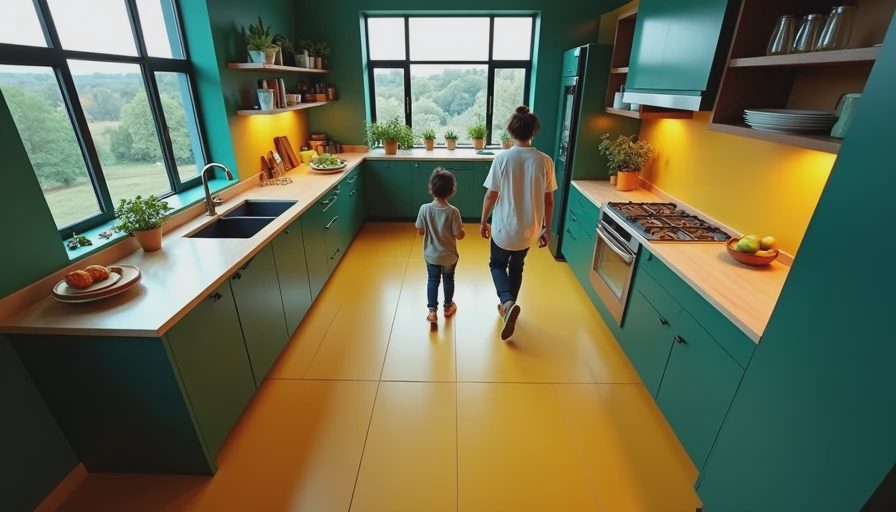
After watching clients choose flooring for years, I'll tell you what I'd install if I were doing my own remodel next month. In a house with a five-year-old and a husband who cooks with cast iron, I'd pick luxury vinyl plank in a warm oak wood look. It's the last thing I ever expected to love, but it's the only kitchen flooring that survived a full month of Henry's cooking experiments without a scratch. I'd go with a mid-range LVP from Shaw or COREtec, which is basically the brand that defined the category. The cost works out to about $5 per square foot, and it comes with a wear layer that handles dropped knives and dragged chairs. If you want something more polished and you don't have small kids, I'd still argue for porcelain tile in a large-format plank size. It gives you the clean lines and easy clean-up of tile without the busy grout lines.
How to Save Without Cutting Corners
Before you pay full retail, here are a few tricks I use with my own clients. First, check the clearance section at your local tile and flooring store. Discontinued styles are often 30 to 50 percent off, and in a kitchen, nobody cares if it's a closeout. Second, install LVP yourself if you're reasonably handy. The planks click together, and a 10x10 kitchen takes a long weekend. You'll save $2 to $4 per square foot in labor. Third, consider using the same flooring throughout the main level instead of switching materials at the kitchen boundary. It makes the space feel bigger, and you avoid spending extra on transition strips. One of my clients saved close to $900 by carrying her dining room hardwood into the kitchen area and using an area rug instead of trying to match tile.
The Bottom Line
The best flooring for your kitchen is the one that fits your life, not the one that looks best in the showroom. If you drop things and stand a lot, pick porcelain or LVP. If you love wood and you're willing to be careful with it, go with engineered hardwood. And if you're on a tight budget, a quality laminate or vinyl can still look great for $2 to $3 per square foot. Whatever you choose, buy the best underlayment you can afford, and don't skip the moisture barrier. A great kitchen doesn't happen by accident. It happens by how you live in it.


No comments yet — be the first to share a thought.