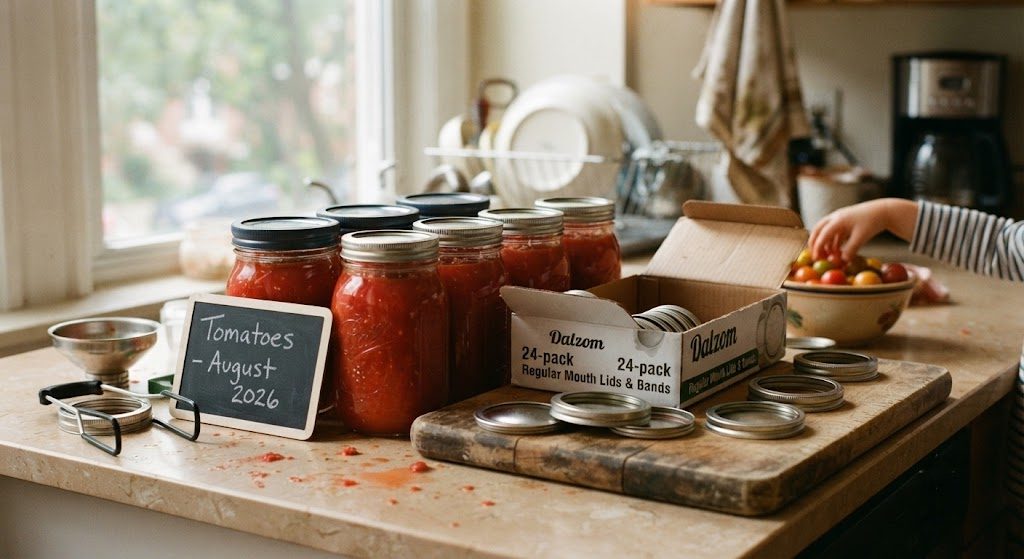
I started canning tomatoes three years ago, which means I'm still new enough to make mistakes and experienced enough to know when the mistake isn't me. August in Chicago means my community garden plot dumps thirty pounds of Roma tomatoes into my kitchen over about two weeks, and I either preserve them or watch them rot. There's no third option.
My first year, I bought Ball lids without looking at the price. My second year, I looked at the price and flinched. This year — year three — I went looking for affordable canning supplies and found the Dalzom 24-piece regular-mouth canning lids on Amazon. 24 lids, 24 rings, $12.79. That's roughly fifty-three cents per set. Ball runs closer to ninety cents. Over a full canning season, that difference adds up.
I bought a box. Here's what happened
🛍️ Shop Dalzom 24-Pack on Amazon
What's in the Box
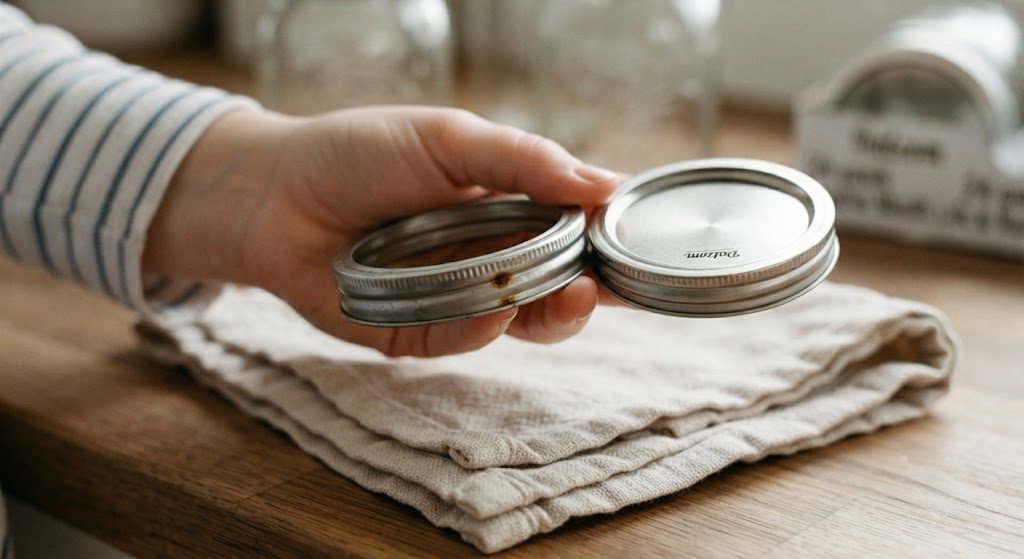
The Dalzom set gives you 24 lids and 24 bands — enough to process two dozen regular-mouth pint or quart jars. The lids are tin-plated steel with a BPA-free silicone sealing ring. They're designed for one-time canning use, like all two-piece mason jar lids and rings. The bands are reusable if you dry them immediately after processing and don't let them sit wet.
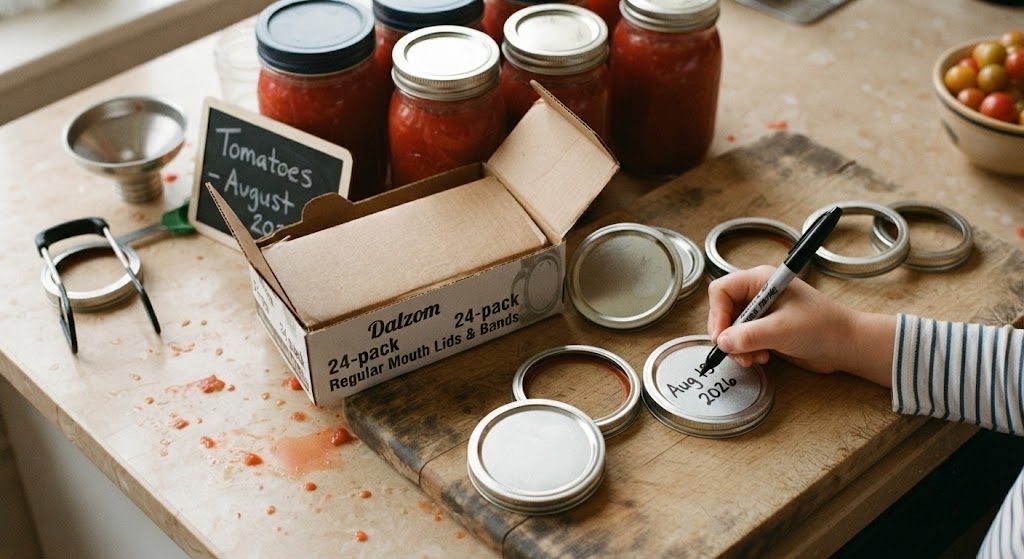
The detail I immediately liked: each lid has a small frosted rectangle on top where you can write the date and contents with a regular pen. No labels needed. No masking tape peeling off in the canner. It's such a small thing, but when you're processing six jars of crushed tomatoes and four of salsa in an afternoon, small things become big things.
The bands feel slightly lighter than the Ball bands I'm used to — thinner metal, maybe a few grams less. I noticed it when I picked one up, but once it was screwed onto a jar and finger-tightened, I couldn't tell the difference. They threaded smoothly. Nothing stripped. Nothing cross-threaded.
What I Canned (And What Actually Sealed)
Over two weekends in late August, I ran three canning sessions. Here's the honest breakdown.
Session One: Water Bath — Crushed Tomatoes
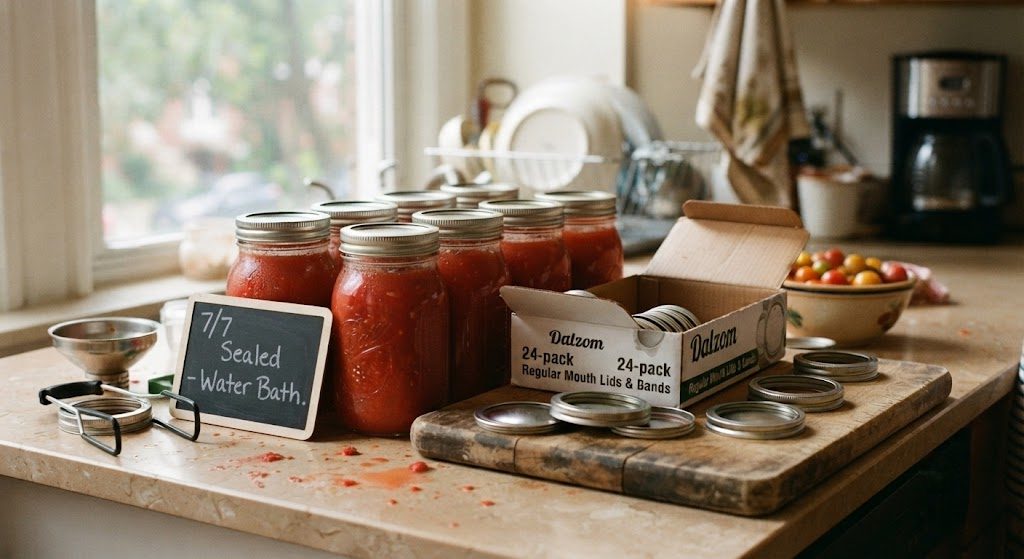
Seven pints of crushed tomatoes. Standard water bath method — hot pack, half-inch headspace, process for 35 minutes. All seven jars came out of the canner with satisfying pops as they cooled on the counter. Seven lids down, seven concave, seven seals. 100% success rate.
This is where the Dalzom canning lids shine. Water bath processing is gentler than pressure canning — lower temperature, less violent boil, less stress on the lid structure. For jams, jellies, pickles, tomatoes, fruit in syrup, salsa — the standard water bath recipes — these lids performed exactly like the name brand.
Session Two: Water Bath — Peach Jam
Five half-pints of peach jam. Same method. Five jars in, five seals. Again, 100%. At this point I was feeling pretty smug. Twelve jars processed, twelve seals, and I'd spent less than seven dollars on the lids.
Session Three: Pressure Canner — Green Beans
This is where the story changes. I pressure-canned six pints of green beans from the farmers market. 10 pounds of pressure, 20 minutes for pints. When the canner cooled and I opened it, two of the six jars hadn't sealed. That's a 33% failure rate. Two lids had buckled slightly — a subtle wave near the edge that you can feel with your finger. The rings were also slightly warped from the heat.
I reprocessed those two jars with Ball lids I had in the drawer. Both sealed immediately. The beans were fine — I caught the failures within an hour of the canner opening — but I lost the lids and the time. In a busy canning season, time is the thing I resent losing most.
This tracks with the reviews I read. Some users reported lids buckling under pressure canner heat. I saw it myself. If you're exclusively a water bath canner, this may never affect you. If you pressure-can low-acid foods — green beans, carrots, soups, stocks, meat — you need to know that these lids are less reliable under high heat and pressure. I'll still use them for water bath canning. I won't use them in the pressure canner again.
The Rust Issue (And How to Avoid It)
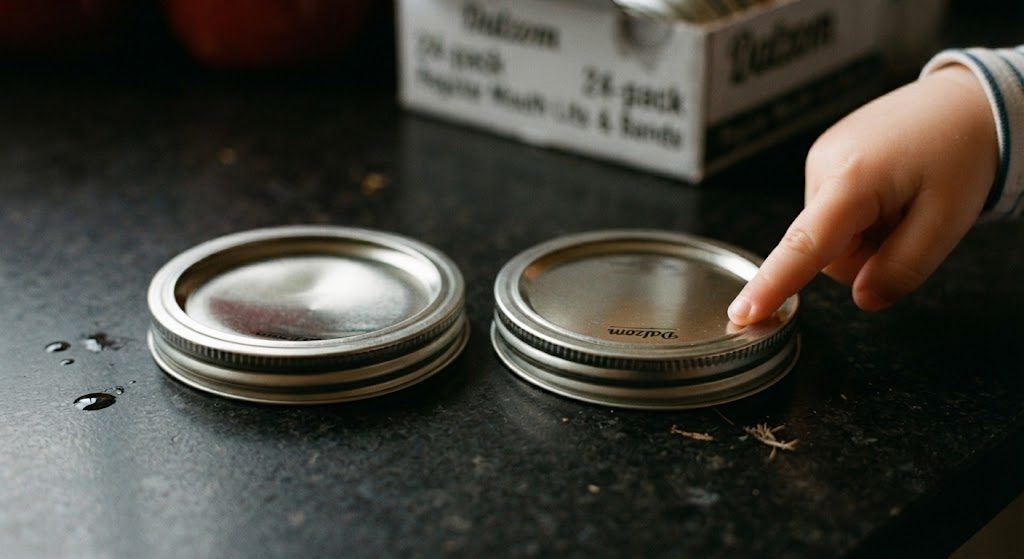
Several reviews mentioned rust on the bands after washing. I saw this on two of mine, and here's what I learned: the rings need to be dried immediately and completely. Don't let them air-dry in a dish rack. Don't leave them on the jar after processing — remove the band once the seal is set, which is standard practice anyway, because leaving bands on during storage can hide a failed seal.
I hand-wash the rings, towel-dry them immediately, and store them in a drawer with a silica gel packet. It's more fussing than I'd like, but it's also not unreasonable for a budget product. If you're the kind of person who tosses everything in the dishwasher and walks away, expect some rust spots within a season or two.
Who Should Buy These
The best budget canning lids aren't the ones that match a name brand in every category. They're the ones that match a name brand where it counts, for the kind of canning you actually do.
Buy these if:
You do mostly water bath canning — jams, jellies, pickles, tomatoes, fruit, salsa
You're new to canning and don't want to sink a fortune into supplies before you know if you'll stick with it
You use jars for dry storage — beans, grains, pasta, spices — where the seal doesn't need to be perfect
You want a bulk pack of regular mouth canning lids for fridge storage and short-term preservation
Stick with Ball or Kerr if:
You pressure-can regularly
You're preserving meat, stock, or low-acid vegetables
You cannot afford to lose a single jar in a batch
You're canning for long-term food storage where seal failure could be dangerous
At $12.79 for 24, the Dalzom set is a genuine Ball lid alternative for the right use cases. For water bath canning and dry storage, I'll keep using them. They're good enough where good enough counts. For pressure canning, I'll spend the extra forty cents per lid and sleep better.
The Seal Check Habit I Already Had (You Need It Too)
This isn't specific to Dalzom. Every canner should check seals after 12 to 24 hours, no matter what brand they used. Press the center of the lid. It should be concave and not flex. Remove the band and try to lift the jar by the lid alone. If it holds, it's sealed. If it pops or lifts, it goes in the fridge.
With the Dalzom lids, I check twice. Once after 12 hours, once again at 24. The two that failed in my pressure canner batch showed themselves early — the lids were flat or slightly domed within an hour of cooling. I caught them, I reprocessed, I lost nothing but the lids.
Final Verdict
Three weeks into tomato season, I'm halfway through my Dalzom pack. The 12 water bath jars are sealed tight in the pantry. The two pressure canner failures went into the fridge and became dilly beans that Henry ate in four days. The rings have a couple of tiny rust spots because I forgot to dry one batch immediately. I know whose fault that was.
These are $0.53 lids that perform like $0.53 lids — which is to say, better than you'd expect for the price, but not invincible. If your canning is gentle and your expectations are realistic, they're a good buy. I'll order another pack next summer for tomatoes and jam and dry storage. For green beans, I'll use Ball.
That's not a criticism. That's knowing your tools.
FAQs
1. Do Dalzom lids fit Ball and Kerr mason jars?
Yes. They're standard regular-mouth size (70mm / 2.76 inches) and thread smoothly onto Ball, Kerr, Bernadin, and most other regular-mouth mason jar brands. I tested them on Ball and Kerr jars — both fit perfectly.
2. Are these reusable for canning?
No. Like all two-piece canning lids, the flat lid is designed for single use in canning. The sealing compound deforms during processing and won't create a reliable seal a second time. The rings are reusable if hand-washed and dried immediately. Used lids can still be used for dry storage or fridge storage.
3. Can I use these in a pressure canner?
Not recommended. I had a 33% failure rate in my pressure canner batch, and other reviews report similar buckling issues. Stick to water bath canning with these lids. For pressure canning, use Ball or Kerr.
4. Do the bands rust?
They can if left wet. Hand-wash and towel-dry the bands immediately after removing them from processed jars. Don't leave them in a dish rack. Don't run them through the dishwasher and forget about them. The metal is not stainless steel.
5. How do they compare to Ball lids?
For water bath canning, they perform similarly in terms of seal rate. The metal is slightly thinner, the bands are slightly lighter, and the pressure canner performance is notably worse. Ball is the safer choice for high-heat canning and long-term meat/stock storage. Dalzom is the better value for water bath canning, dry storage, and fridge use.
A great kitchen doesn't happen by accident. It happens by how you live in it.


No comments yet — be the first to share a thought.