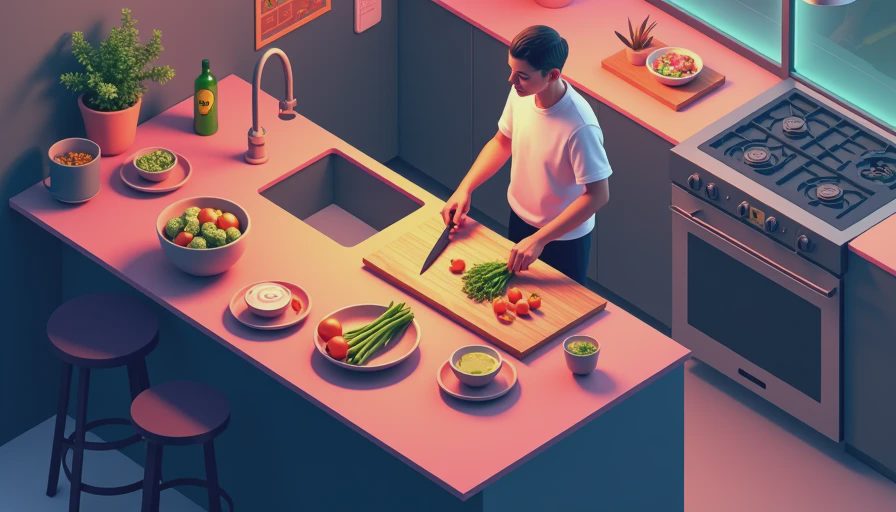
Last Saturday, Henry shoved a pile of strawberries toward me while I was chopping basil, and the board under my knife made me think, again, why an end grain cutting board keeps showing up in the kitchens I design and the one I live in. It is not the cheapest option on the counter, but it has a very specific kind of everyday value: it feels kinder to the knife, stays put better than a flimsy slab, and makes even a fast dinner prep feel a little more solid. If you have ever used a lightweight plastic board that skated across the counter, you already know the appeal. The question is whether the price, weight, and care routine make sense for your kitchen.
What makes an end grain cutting board different
The easiest way to understand this style is to picture a bundle of straws standing upright. A knife cuts into the ends of those fibers instead of slicing across them, which is why the surface tends to feel softer and why the board can look almost self-healing after a lot of use. That is the big draw of an end grain cutting board, especially if you use a good chef's knife and want to protect the edge a little longer between sharpenings.
It also has a certain visual warmth that works in real kitchens, not just styled ones. Maple looks classic and bright, walnut brings in a deeper tone, and cherry picks up a richer color over time. A well-made board usually costs more because it takes more labor to piece together and flatten. In the sizes most homeowners buy, expect roughly $120 to $250 for a solid small-to-medium board and more for a thick butcher-block style version. John Boos is a familiar name in this category, and there are plenty of other respectable makers at similar price points.
Not every wooden board deserves the same praise, though. An edge-grain board can be perfectly good and usually costs less. Bamboo is hard and attractive, but it is not the same feel under a knife. The end grain version is the one people reach for when they want a prep surface that feels a little more forgiving and a little more substantial.
What to look for before you buy
Start with thickness. A board that is around 1.5 to 2 inches thick has enough heft to resist sliding and enough mass to stay steady during chopping. If it is much thinner, it may look nice online and feel disappointing in person. I also like a board with rubber feet or enough weight to stay anchored, because nobody wants to chase onions around the counter.
Shape matters more than people expect. A rectangular board in the 18 by 12 inch range works well for smaller kitchens, while a family that cooks often will probably appreciate something closer to 20 by 15 inches. A juice groove is useful if you cut tomatoes, citrus, or meat, but a flat reversible board is easier to flip and use on both sides. Look closely at the glue lines and the seam pattern. You want tight joints, even blocks, and a surface that feels flat when you press it onto the counter.
Wood species also affect daily life. Maple is the sturdy workhorse and a good first choice. Walnut is gorgeous and a little darker, so it hides stains better. Cherry can be beautiful but will deepen in color with time. I would skip anything that feels overly rough, smells heavily of finish, or rocks on the counter right out of the box. If the board cannot sit flat in the store, it is not going to behave better at home.
How to care for it without babying it
An end grain cutting board should be hand-washed, dried right away, and never left soaking in the sink overnight. That is the fastest way to make a nice board warp or split. I know because I have done the lazy version more than once, usually after a late dinner and a glass of wine, and then regretted it the next morning.
Mineral oil is the basic maintenance step that matters most. A new board often wants several coats over the first week, then a refresh every few weeks if you cook often. If the surface starts looking dry or pale, it is telling you it needs oil. Some people like a board cream with beeswax for a little extra moisture resistance, which is useful in dry winter kitchens like mine in Chicago. Wipe it on, let it sit, and buff the excess off.
A few habits make a bigger difference than fancy products. Do not use the dishwasher. Do not set a wet board flat against a backsplash. Do keep one side for produce if you want the board to stay cleaner longer. The goal is not perfection; it is a simple routine that keeps the wood stable and ready for the next dinner.

When the upgrade makes sense
If you cook most nights, chop a lot of herbs and vegetables, or care about keeping your knives sharp, this is one of the few countertop purchases that feels like a genuine upgrade instead of a decor choice. If you are buying an end grain cutting board for the first time, think of it as a long-term tool rather than a quick accessory. A $20 plastic board may be perfectly fine for raw chicken or a last-minute grilled cheese, but it will not give you the same balance, weight, or pleasure in use.
That said, it is not a must-have for every kitchen. If you mostly reheat takeout, make toast, and cut the occasional apple, a simpler board will serve you well. The people who get the most value out of this one are the cooks who prep onions, carrots, garlic, herbs, and bread every week and want one surface that feels calm and substantial. In that kind of kitchen, the price starts to make sense.
How I would shop for one this week
I would measure the counter space first, then decide whether I want a board that lives out full time or one that slides into a cabinet. For most families, 18 by 12 inches is the smallest size that still feels useful, while 20 by 15 gives enough room for a roast chicken and a pile of vegetables without crowding the knife work. If you can swing a thicker board, do it. The extra mass matters more than the glossy finish.
I would also set my budget before I start looking, because the jump from a basic wood board to a well-made end grain cutting board is usually less about luxury and more about labor, weight, and how long it is meant to last. Good ones often sit in the $150 to $300 range, and that is not an accident. You are paying for density, flatter glue-ups, and a surface that can be renewed instead of replaced. For me, an end grain cutting board is the kind of purchase that pays you back in quieter knife work and fewer annoyances, which is about as practical as kitchen luxury gets.
A great kitchen doesn't happen by accident. It happens by how you live in it.

No comments yet — be the first to share a thought.