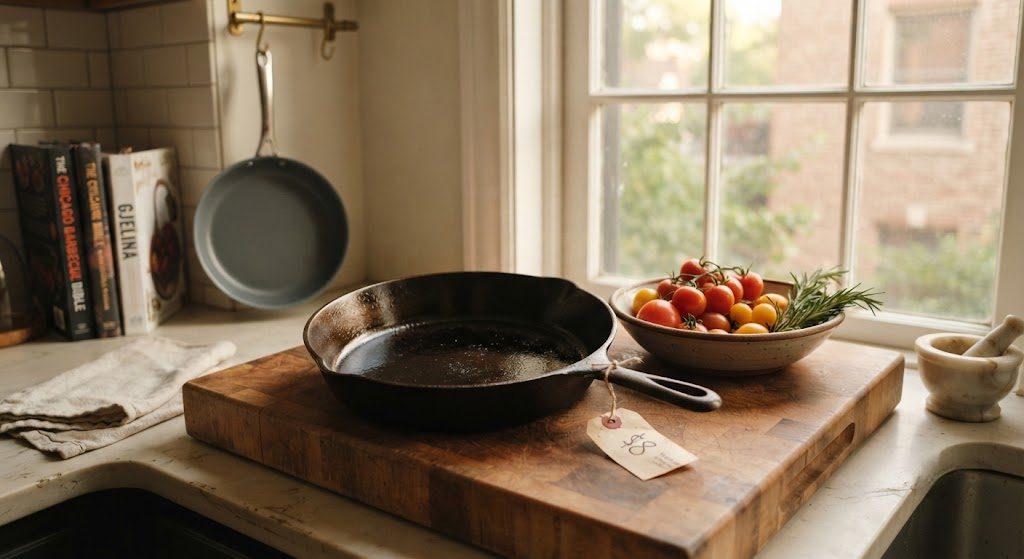
My first cast iron skillet came from a garage sale in Logan Square. It cost $6. It was rusted, crusted with something that might have been bacon grease from the Carter administration, and so heavy I almost left it on the card table.
That was seven years ago. I stripped it, seasoned it, and cooked with it. It's now the smoothest pan in my kitchen — darker and glossier than any new Lodge, slick enough that scrambled eggs slide around like they're on Teflon. I've picked up three more vintage cast iron pans since then, and I've learned what to look for, what to walk away from, and how to bring the good ones back to life.
What Makes Vintage Cast Iron Better
Old cast iron is different from new cast iron. The difference is the cooking surface.
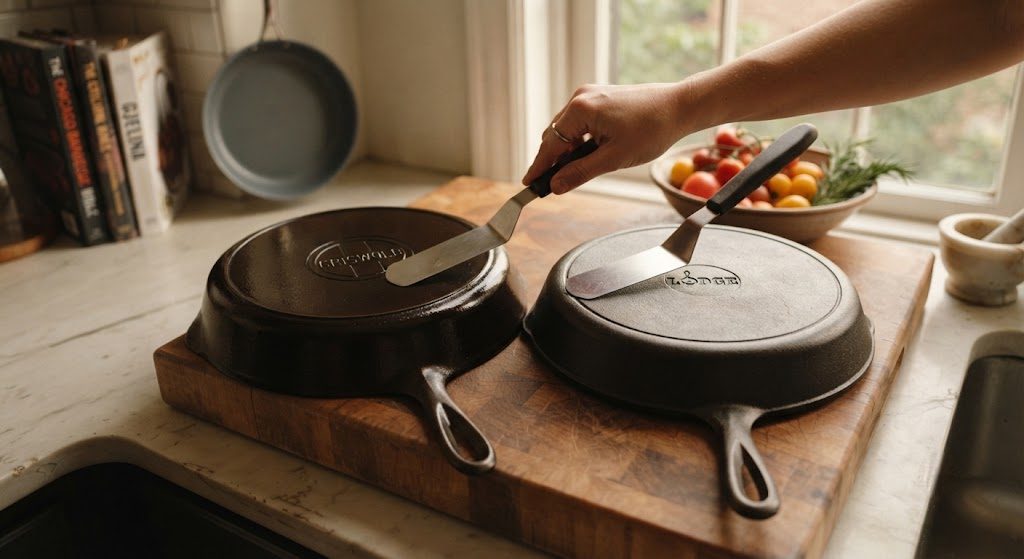
Modern cast iron — the kind you buy at a hardware store or big-box retailer — comes from the factory with a pebbly, slightly rough texture. That's the surface of the sand mold the iron was cast in. Modern manufacturers don't machine the cooking surface after casting. They season over the pebbly texture and ship it out.
Vintage cast iron from brands like Griswold, Wagner, and old Lodge was machined after casting. The cooking surface was ground smooth at the factory. A vintage Griswold skillet feels almost like glass under a spatula. Food releases differently. The seasoning builds more evenly. Vintage cast iron skillets from Griswold and Wagner have a machined-smooth cooking surface that modern Lodge pans lack — they're lighter, slicker, and worth hunting for at thrift stores.
That smooth surface is what you're hunting for. When you pick up a pan at a thrift store and run your fingers over the inside, you should feel a difference. The old ones are smooth. The new ones are textured. Both cook well eventually, but the vintage pans start with an advantage.
How to Spot a Good One
I've walked past hundreds of cast iron pans at garage sales and thrift stores. Here's what I check before I buy.
The flatness test. Set the pan on a flat surface — a table, a shelf, the floor if the seller doesn't mind. Try to rock it. A warped pan wobbles. A warped pan won't sit flat on a glass-top stove and will heat unevenly on any burner. Wobble means walk away. This is the most common fatal flaw in used cast iron, and it's not fixable.
Cracks. Look closely at the cooking surface and the rim. Hairline cracks spread. If the pan has a crack anywhere, it's decorative, not functional. Leave it.
Pitting. Surface rust is fine — you can strip it. But deep pitting, where the iron has corroded into small craters, is harder to fix. Light pitting will fill in with seasoning over time. Pitting deep enough to catch a fingernail means the pan has lost metal. It'll still cook, but it won't be great.
The weight test. Pick up the pan. Vintage cast iron is often thinner and lighter than modern cast iron. A vintage Griswold No. 8 skillet weighs about 5 pounds. A modern Lodge equivalent weighs closer to 6. The lighter pan heats faster and is easier to handle one-handed. If you find a pan that feels noticeably light for its size, check the brand — it might be something good.
Brands Worth Knowing
Griswold is the collector's brand. Pans marked "Griswold" with a cross logo on the bottom are from Erie, Pennsylvania, and were made before 1957. They're the smoothest cast iron I've ever cooked on and the most expensive at antique stores — but still findable at garage sales where the seller doesn't know what they have. A Griswold No. 8 in good condition costs $60 to $120 at retail. At a garage sale, I've seen them for $15.
Wagner Ware is nearly as good and less collected, which means lower prices. Wagner pans from Sidney, Ohio, were also machined smooth. A Wagner No. 8 in good condition runs $25 to $50. These are my favorite finds — Griswold quality without the Griswold premium.
Unmarked vintage Lodge pans are the sleeper deal. Before Lodge started putting their name on everything, they made pans with a single notch in the heat ring and no branding. These pans are vintage, machined smooth, and often sell for $10 to $20 because they don't say anything on the bottom. I have one of these. It cooks identically to my Wagner.
Modern Lodge is fine. It's what I recommend to people who want a new pan they can use tomorrow. The pebbly surface smooths out with years of use and seasoning. But at a thrift store, you can find something better for less money.
How I Restore a Thrift Store Pan
My restoration method is simple. No power tools. No oven cleaner in a garbage bag in the backyard. I've done that method and it works, but it's messy and takes days and I don't want chemicals near where Henry plays.
Here's what I do instead.
Strip the old seasoning. I scrub the pan with steel wool and hot soapy water until the loose rust and old seasoning are gone. Soap is fine for this step — you're stripping everything anyway. For stubborn spots, a paste of coarse salt and a little water scrubbed with a rag works as a gentle abrasive. This takes about twenty minutes of scrubbing. Put on a podcast.
Dry immediately and completely. Rust forms fast. I dry the pan with a towel, then put it on a burner over low heat for a few minutes until every trace of moisture is gone. The pan should feel warm and bone-dry.
Season in thin layers. I rub the entire pan — inside, outside, handle — with a thin layer of grapeseed oil or vegetable shortening. Then I wipe it off like I made a mistake. The pan should look almost dry. Too much oil leaves a sticky, uneven finish. I place the pan upside down in a cold oven with a sheet of foil on the rack below to catch drips. Heat to 450 degrees for one hour. Turn off the oven and let the pan cool inside overnight. Repeat two or three times.
The pan will look uneven at first. That's normal. The seasoning builds and darkens with use. Don't chase a perfect black finish on day one. It'll come.
What I Cook First
After a fresh seasoning, I start with foods that build the surface. Bacon. Roasted potatoes with plenty of oil. Cornbread with butter melted in the pan before the batter goes in. Nothing acidic — no tomatoes, no wine, no lemon. Acid strips young seasoning. Give the pan a few weeks of fatty cooking before you attempt a pan sauce.
Henry's favorite is the cornbread. He calls the first cornbread in a restored pan "new pan cake." I don't correct him.
A great kitchen doesn't happen by accident. It happens by how you live in it.

No comments yet — be the first to share a thought.