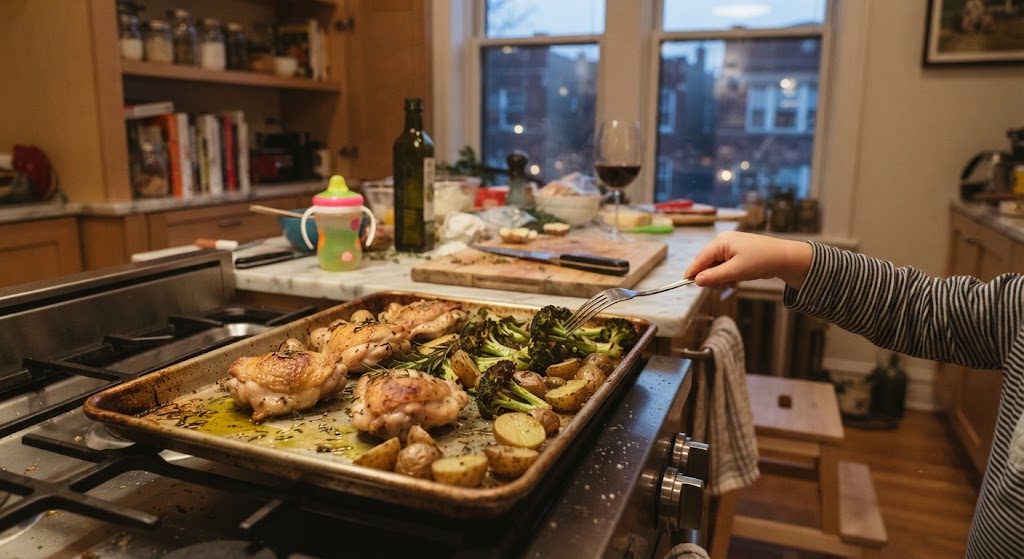
It's 5:45 PM on a Tuesday. Henry is drawing at the kitchen island, which means he's drawing on the kitchen island because he can never find paper. Jack is stuck in traffic on the Kennedy. I haven't thought about dinner.
This is the moment when takeout menus start whispering to me. Thai food. Pizza. That place with the burritos that Henry won't eat but Jack and I will. But it's Tuesday, and we've already ordered takeout once this week, and there's a package of chicken thighs in the fridge that I bought on Sunday with good intentions.
So I make the sheet pan dinner. I've made it twice a week for two years now. It's not a recipe. It's a survival strategy.
The Formula
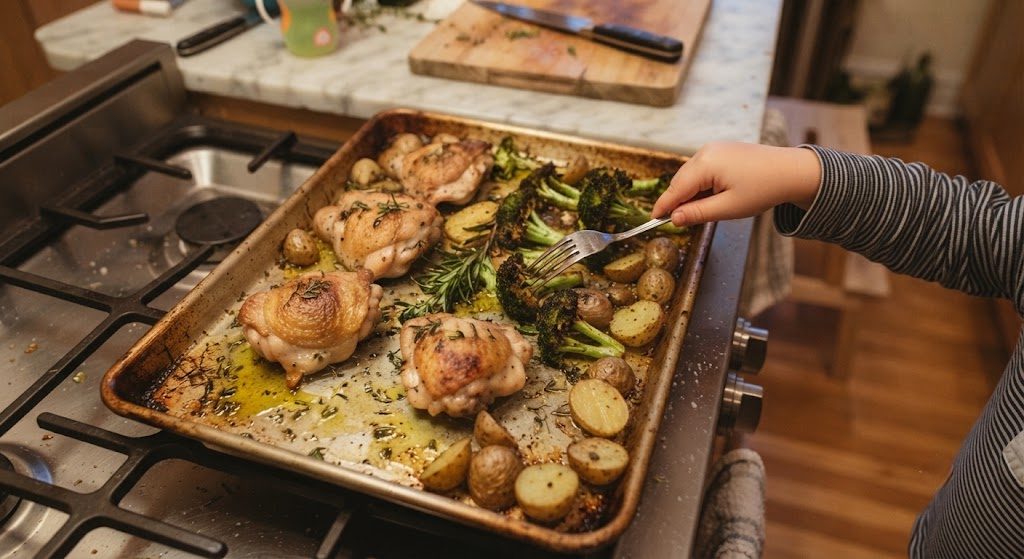
A sheet pan dinner is the simplest thing in the world. Protein, vegetables, oil, salt, heat. Everything goes on one pan. Everything roasts together. Everything comes out at roughly the same time if you know your oven and your ingredients.
The formula I use: chicken thighs (bone-in, skin-on if I can get them, but boneless works), two or three vegetables cut to roughly the same size, olive oil, kosher salt, and whatever herbs are still alive on the windowsill or dried in the cabinet. Forty minutes at 425 degrees. That's it.
The chicken thighs are the anchor. They stay juicy when roasted, unlike breasts which dry out if you look away for thirty seconds. The vegetables roast in the fat that renders from the skin. By the time the chicken is done, the vegetables are caramelized and soft and tasting like they took way more effort than they did.
I've made variations of this meal with salmon, with sausage, with chickpeas and cauliflower when I was trying to eat less meat for a month. But chicken and whatever-vegetables-are-in-the-fridge is the default. It's the dinner I make when I don't have a plan. It's the dinner that's become such a habit that Henry, at five, can tell me which vegetables "go with sheet pan chicken" and which ones don't. Broccoli goes. Carrots go. Potatoes go. Cucumbers, he has informed me, do not go, because "cucumbers get weird when they're hot, Mama." He's not wrong.
Why It Works for Families
Here's the thing about weeknight cooking with a kid in the house. You can't stand at the stove. You can't sauté. You can't manage a pan sauce while a small person asks you seventeen questions about whether squirrels hibernate. You can, however, chop things, put them on a pan, and put that pan in the oven. Then you have forty minutes.
Forty minutes is enough time to set the table with Henry, to pour a glass of wine, to help Jack unload the dishwasher when he finally gets home, to answer the squirrel questions. It's enough time to not feel like dinner is happening to you.
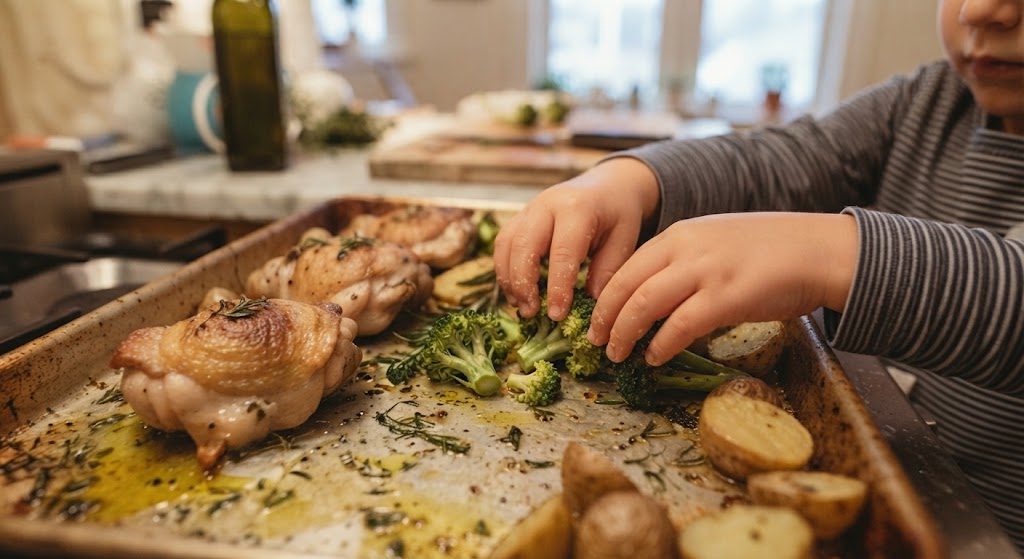
Henry's job is the broccoli. I cut the florets, and he arranges them on the pan. Some go face-down, some go face-up, some end up clustered in one corner. I don't fix it. The unevenness means some pieces get extra crispy and some stay tender, and Henry thinks the crispy ones are "broccoli chips." He eats them with his fingers. I'm not going to correct a five-year-old who voluntarily eats broccoli.
What I've Learned After Two Years
The sheet pan is a technique, not a recipe. Here's what makes it work every time.
Space matters. If the pan is crowded, the food steams instead of roasts. Use two pans if you need to. I learned this the hard way with soggy potatoes and pale chicken skin. Give everything room to breathe.
Cut everything the same size. Carrots, potatoes, broccoli stalks should all be roughly the same thickness so they finish at the same time. This seems obvious. It took me a year to actually do it consistently.
Line the pan with parchment or foil. You don't have to. But you'll want to, because roasted chicken fat caramelizes into a substance that could patch drywall, and scrubbing it off a sheet pan at 9 PM is not the evening anyone wants.
Rotate the pan halfway through. My oven has a hot spot in the back left corner. Yours probably has one too. Turn the pan once, and everything cooks evenly.
Acid at the end. A squeeze of lemon or a splash of vinegar after the pan comes out of the oven wakes everything up. It's the difference between dinner that tastes like you tried and dinner that tastes like you gave up.
The Vegetables That Work
After dozens of these dinners, here's what holds up. Broccoli and cauliflower get crispy at the edges. Brussels sprouts caramelize. Sweet potatoes and regular potatoes both work, cut into inch-sized pieces. Red onion wedges get jammy and sweet. Bell peppers soften into something almost like a confit. Cherry tomatoes burst. Zucchini works but gets watery if you crowd the pan — use it sparingly or roast it on a separate pan if your kid loves it.
The vegetables that don't work: leafy greens wilt into nothing and burn. Cucumbers, as Henry noted, get weird. Anything that's mostly water will steam rather than roast and leave you with a puddle on the pan.
This Isn't a Recipe Blog
I'm not here to give you precise measurements. Sheet pan dinners don't need them. Use enough olive oil to coat everything generously. Use enough salt that it feels like slightly too much. The oven does the rest.
What I'm telling you is this: if weeknight dinners feel like a crisis, pick one meal that requires no thinking and make it twice a week until it becomes automatic. For us, that's the sheet pan. For you, it might be a big salad, a pot of beans, a frittata. The specific meal matters less than the habit.
At 6:30 PM, the chicken comes out of the oven. The skin is crisp and the broccoli is charred at the edges and the potatoes are soft inside. Jack is home. Henry is telling him about broccoli chips. I put the pan on the table because I'm not dirtying a serving dish, and we eat directly from it, and no one complains.
It's Tuesday. We're fine.
A great kitchen doesn't happen by accident. It happens by how you live in it.

No comments yet — be the first to share a thought.