Last Tuesday, Henry opened the utensil drawer while I was draining pasta and pulled out three wooden spoons, a measuring cup, and one mysterious battery. The pasta water kept boiling, the drawer jammed halfway, and I remembered why a drawer organizer matters more than it seems. This small insert can turn a daily kitchen irritation into a smooth, one-handed routine, but only if it fits your drawer and the way your household cooks.
I have specified drawer interiors for dozens of kitchen remodels, and the most common mistake is buying the prettiest tray before measuring. A $12 bamboo model can outperform a $45 adjustable insert when its compartments match your tools. Start with the inside width, depth, and height of the drawer, not the cabinet opening. Then inventory what actually lives there. If you own six spatulas and rarely use steak knives, the layout should reflect that reality.
Measure the drawer before shopping
Remove everything and measure the usable interior with a tape measure. Record the narrowest width from side to side, the depth from the front panel to the back, and the clearance above the drawer box. Older cabinets often have hinges, plumbing, or drawer slides that reduce the available space. A drawer organizer listed as 17 inches wide may require a full 17 inches, leaving no room for adjustment.
Leave about half an inch of breathing room around a fixed tray so it can be lifted out for cleaning. For an expandable drawer organizer, confirm both the minimum and maximum dimensions. A tray that fits at its smallest setting may become unstable when stretched too far. I also check whether the drawer bottom is flat; a slightly bowed particleboard bottom can make a rigid tray rock every time you open it.
Think about depth, too. A shallow 2-inch drawer needs low compartments for flatware and peelers. A deeper 4-inch drawer can hold measuring cups, whisks, and serving utensils, but tall dividers can hide smaller pieces. Taking five minutes to measure is less exciting than browsing product photos, but it prevents the very common return-and-reorder cycle.

Match the material to real kitchen use
Bamboo looks warm and works beautifully in a dry flatware drawer. Models from OXO and Yamazaki often have a clean, restrained look that suits a modern kitchen, while simpler bamboo trays from Target or IKEA can cost roughly $10 to $25. Bamboo is not waterproof, so I would not place it directly beneath a frequently leaking dish rack or in a drawer where wet tools are tossed after washing.
Plastic is the practical choice for messy family kitchens. A clear or gray drawer organizer can be wiped clean after a spice spill, and many options cost $3 to $15 per tray. Rubberized feet help prevent sliding, especially when a child is opening the drawer quickly. Look for smooth corners rather than deep seams where flour and crumbs can collect.
Metal mesh has a lighter visual feel and can be useful for office-style utility drawers, but it is less forgiving with tiny pieces. Stainless steel inserts are durable and easy to sanitize, though they often cost $30 to $70. For most kitchens, the best drawer organizer is not the most expensive material; it is the one you will clean without resenting it.
Choose compartments based on your habits
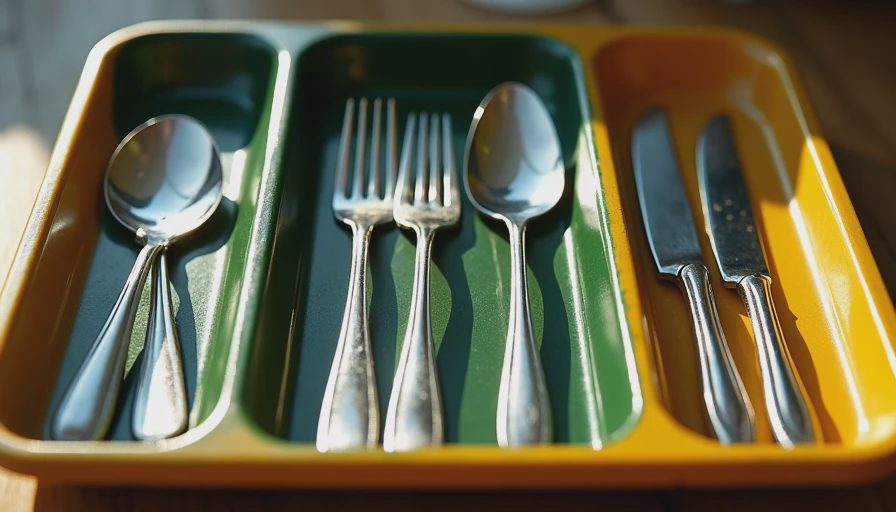
Flatware is easiest when forks, knives, and spoons have separate lanes, with a wider section for serving pieces. If your family uses chopsticks, cocktail forks, or reusable straws, reserve a compartment before buying. Combining every small item into one long bin creates the familiar problem of digging through a pile for the teaspoon you need for coffee.
For cooking tools, consider a wide drawer organizer with fewer, longer sections. A narrow slot may fit one turner but fail on a silicone spoon with a thick handle. I like separating everyday tools from occasional ones: spatulas, tongs, and a whisk in front; a melon baller, pastry brush, and corn holders farther back. That arrangement saves more time than a perfectly symmetrical grid.
At our house, Henry can return measuring spoons to a labeled section without help, but he cannot reliably stack them by size. A drawer organizer should support the least precise person using the kitchen. If returning an item requires a puzzle, the system will last until the first busy Wednesday.
Adjustable trays versus custom inserts
An adjustable drawer organizer is usually the best starting point for renters, budget refreshes, or cabinets with unusual dimensions. Spring-loaded sides or movable dividers let you change the layout as your cooking changes. Expect to spend $15 to $40 for a solid option. The tradeoff is that moving parts can leave small gaps where teaspoons and garlic press handles collect.
Custom wooden inserts give a built-in appearance and make excellent use of every inch. They are worth considering during a remodel, particularly for a narrow 9-inch drawer or a deep drawer dedicated to knives. A custom insert can add $100 to $300 depending on wood, finish, and installation. It is beautiful, but it also commits you to one arrangement. If you are still experimenting with where tools belong, test the layout with inexpensive bins first.
There is a useful middle ground: modular trays. Several small compartments can be arranged inside one drawer, so you get flexibility without a loose collection of mismatched containers. Measure each tray together rather than assuming a brand's “modular” claim guarantees a perfect fit.
Mistakes that make organization worse
The first mistake is filling every inch. A drawer needs a little visual and physical breathing room, or items catch when the drawer opens. The second is placing a deep drawer organizer in a shallow drawer. The front may close while the tray still scrapes the cabinet above it. The third is putting heavy knives beside delicate utensils. A chef's knife can damage bamboo dividers and create a safety issue when someone reaches in quickly.
Avoid storing food, cleaning chemicals, and utensils together. A drawer organizer can separate tools, but it cannot make an unsuitable location hygienic. Keep sharp knives in a dedicated block, in-drawer knife insert, or magnetic solution installed safely away from children's reach. For a rental, a covered countertop block may be more practical than forcing knives into a crowded drawer.
Finally, do not organize around the catalog photograph. Organize around breakfast, dinner, lunch packing, and the moments when one hand is occupied. The most attractive layout is the one that still works when someone is holding a hot pan.
A simple setup you can finish this week
Empty the drawer, wipe the inside, and discard duplicates or tools nobody uses. Group the remaining pieces by task, then place the most frequently used items nearest the front. Test the arrangement for three days before trimming packaging or purchasing a second tray. Notice what gets returned incorrectly and what still feels awkward.
For a typical 24-inch kitchen drawer, I might use one 15-inch flatware tray, two small bins for measuring spoons and clips, and an open section for tongs. For a narrow 12-inch drawer, one compact organizer is usually better than two cramped containers. Spending $20 on the right fit can make a larger difference than replacing an entire cabinet door.
A great kitchen does not happen by accident. It happens by how you live in it. Choose the drawer organizer that suits your measurements, your cleanup tolerance, and the hands that use the kitchen every day. Then take the next practical step this week: measure one drawer, remove what does not belong, and give every remaining tool a reachable home.





No comments yet — be the first to share a thought.