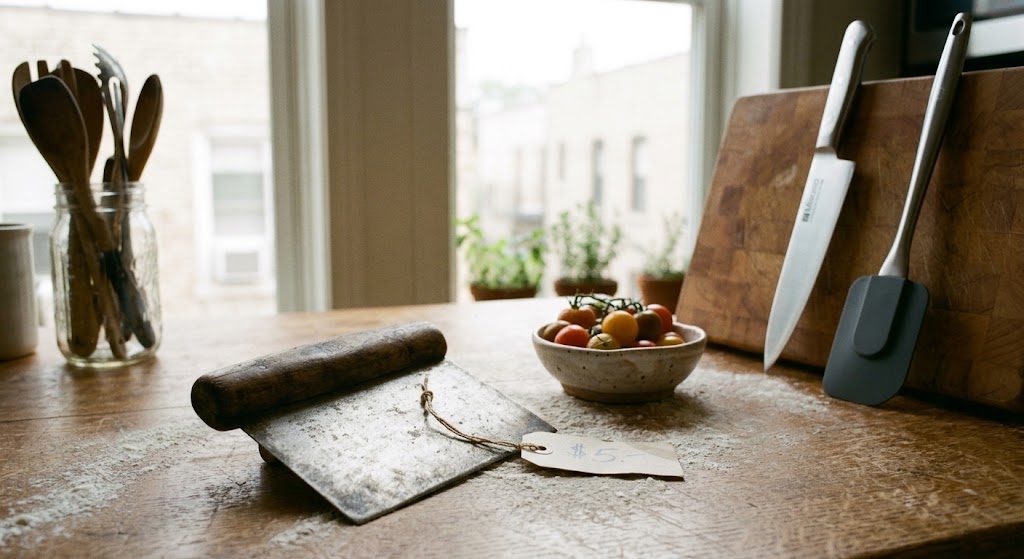
The best tool in my kitchen cost five dollars. It has no brand name etched on the blade. No packaging. No influencer affiliate link. It came to me from a card table in a Lincoln Park garage, next to a box of mismatched silverplate and a lamp shaped like a pineapple.
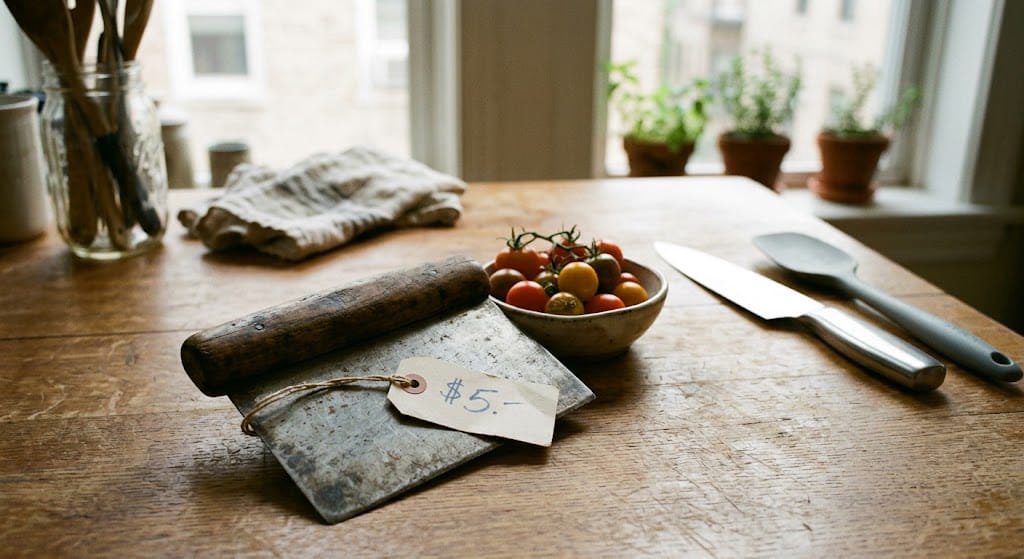
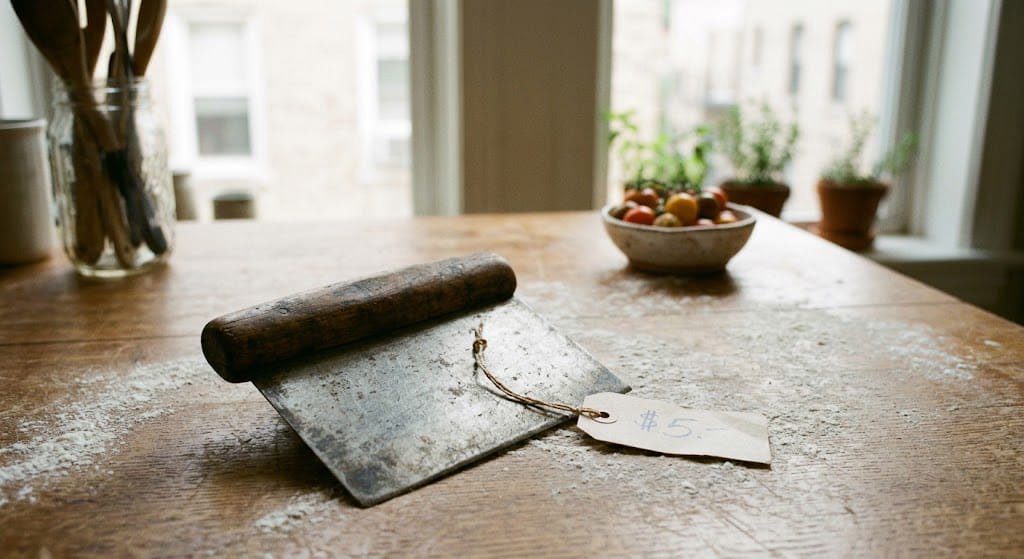
It's a wooden dough scraper. The handle is worn smooth in a way that only decades of hands can achieve. The metal blade has a gentle patina that new tools fake with acid washes and call "artisan." The blade is slightly curved from years of use — not damaged, just shaped by work. When I picked it up at that garage sale three years ago, an elderly woman named Ruth told me it had belonged to her mother, who used it every day for bread, for pasta, for scraping flour off the counter. Ruth was selling it for five dollars because her own kitchen was downsizing and she wanted it to go to someone who would actually use it.
I use it every single day.
What This $5 Tool Does Better Than My Modern Gear
The dough scraper — sometimes called a bench scraper, a pastry scraper, or a board scraper — is not a complicated tool. It's a rectangle of metal with a handle. It cuts dough. It scoops chopped vegetables off a cutting board. It scrapes dried pancake batter off the counter. It divides a batch of cookie dough in half. It transfers diced onions from board to pan.
My five-dollar vintage one does all of this better than the three modern scrapers I've owned and discarded over the years. The blade is thinner than any modern version I've found, which means it slides under sticky dough instead of pushing it around. The handle is real wood, shaped by use, fitting my palm perfectly. The metal has a spring to it — a slight flexibility that modern stainless steel scrapers don't have. I can press it flat against the counter and it makes full contact. I can use it to portion dough and it cuts cleanly without dragging.
The modern scrapers I tried had problems. One had a thick plastic handle that felt bulky. One had a blade so stiff it didn't flex against the counter, leaving a thin film of flour behind every time. One had a rubberized grip that started peeling after six months, leaving black specks in my pie dough. All of them cost more than five dollars.
The best vintage kitchen tools were made in an era when things were built to be used daily for a lifetime — they often outperform modern equivalents that were designed to be manufactured cheaply. The tools in my grandmother's kitchen weren't designed by a product team trying to hit a price point for a big-box retailer. They were designed to work, and then to keep working.
Five Vintage Kitchen Tools Worth Hunting For
I spend a lot of Saturday mornings at Chicago estate sales, garage sales, and thrift stores. Over the years I've learned which vintage kitchen tools are worth buying and which ones are just someone else's drawer clutter. Here's what I look for.
Cast Iron Skillets (Pre-1960s)
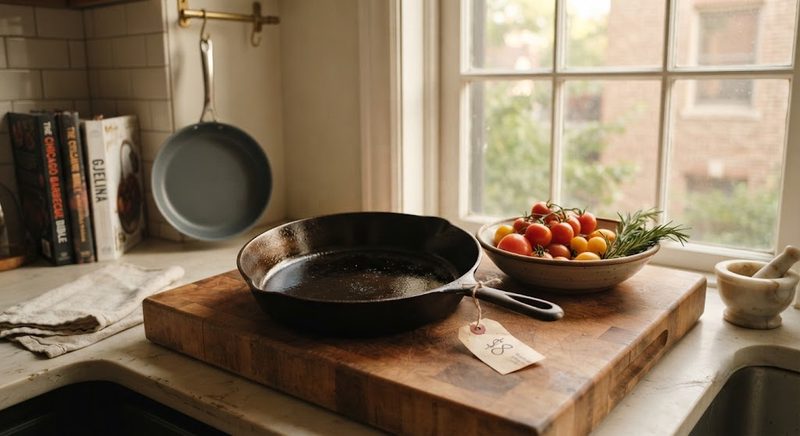
Old cast iron is smoother than new cast iron. Modern cast iron skillets come from the factory with a pebbly surface — that's the texture of the sand mold they were cast in. Vintage cast iron, especially from brands like Griswold and Wagner, was machined after casting to create a glassy-smooth cooking surface. You can feel the difference the moment you run a spatula across it.
What to look for: No cracks, no warping (set it on a flat surface and check for wobble), no pitting from rust that went too deep. Surface rust is fine — you can restore it. A vintage Griswold or Wagner skillet costs $20 to $60 at an estate sale, which is less than a new Lodge and dramatically better to cook on. I'll do a whole post on cast iron restoration soon.
Wooden Spoons and Spatulas (Solid Wood, One Piece)
A vintage wooden spoon made from a single piece of hardwood — beech, maple, olive — will outlast the laminated modern versions that split at the seam after a year in the dishwasher. Old wooden tools have a density you can feel. They're heavier. The edges are rounded from use. They don't have that raw, splintery feel that new unfinished wooden spoons sometimes have.
What to look for: No cracks at the bowl of the spoon or where the handle meets the spatula head. No sticky residue that suggests the finish has degraded. A spoon that's been used for decades will have a dark, almost polished surface — that's seasoning, not dirt, and it's exactly what you want.
Manual Coffee Grinders
I don't grind my coffee by hand every morning — let's be honest, I have a five-year-old and I'm not a monk. But a vintage manual coffee grinder with a wooden drawer and a cast iron mechanism makes better cold brew concentrate than any electric grinder I've used. The grind is inconsistent in a way that actually helps with cold brew extraction.
What to look for: The burr mechanism turns smoothly. The wooden drawer isn't cracked. The handle is intact. European brands like Peugeot and Zassenhaus show up regularly at estate sales for $15 to $30.
Pyrex Mixing Bowls (Primary Colors, 1940s-1950s)
I wrote about vintage Pyrex patterns in more detail in another post, but the short version: the old primary-color mixing bowl sets are nearly indestructible and they nest perfectly. The glass is thicker than modern Pyrex, which is made from a different formula (soda-lime glass instead of borosilicate) and is more prone to thermal shock. I've dropped a vintage yellow Pyrex bowl onto a tile floor from counter height and it bounced. Do not try this on purpose, but know that it happened.
What to look for: No chips on the rim or the nesting ridge. Fading is cosmetic and doesn't affect function. A complete set of four nesting bowls in good condition usually runs $30 to $60 at an estate sale.
Stainless Steel Flatware (Heavy, Unbranded, Pre-1970)
This one surprises people. Old heavy-gauge stainless steel flatware — the kind you find in a shoebox at a garage sale for eight dollars — is often better balanced and more durable than new flatware sets costing ten times as much. The steel is thicker. The forks have a taper that modern stamping processes don't replicate. The knives have a heft that feels right in your hand.
What to look for: Pick up a fork. It should feel substantial. The tines should be straight, not bent. The knife blade should be firmly attached to the handle — some vintage flatware has blades that have loosened over decades. A set of service for eight usually costs $15 to $40 at an estate sale.
What to Leave Behind
Not everything old is good. I've learned to walk past these items without hesitation.
Plastic-handled anything from the 1970s. Bakelite is fine — that's a hard, vintage plastic that's actually collectible. But the soft plastic handles on 1970s utensils degrade, get sticky, and can harbor bacteria in micro-cracks. Leave them.
Electric appliances from before 1990. Old stand mixers are an exception (a 1970s KitchenAid is a tank). But vintage toasters, blenders, and electric knives have wiring that may be unsafe, parts that can't be replaced, and motors that were never meant to run for forty years. I don't gamble on old wiring.
Non-stick cookware with scratches. Any scratch in a non-stick surface means the coating is compromised. Vintage non-stick is even more questionable because the coatings used decades ago weren't the same as modern formulations. If it's scratched, it's trash.
Copper cookware with worn lining. Vintage copper pans are beautiful. The tin lining on the inside wears down over time, exposing the copper underneath. Re-tinning a pan costs $60 to $100, which can be worth it for an heirloom piece but not for a random estate sale find. Check the lining.
The Rule That Guides My Estate Sale Shopping
I have one question I ask myself before buying any vintage kitchen tool. Not "is it pretty?" (though I appreciate pretty). Not "is it a good deal?" (though five dollars for a dough scraper is a very good deal). The question is: Am I going to use this tomorrow?
If the answer is no, I leave it. Someone else will find it and maybe they will use it. My kitchen is not a museum of vintage kitchenware. It's a kitchen where things get used. The dough scraper lives on a magnetic strip. The cast iron lives on the stove. The Pyrex bowls are in the cabinet, not on a display shelf. I buy things to cook with.
Ruth, the woman who sold me the dough scraper, asked me what I was going to do with it. I told her I'd use it that night — I was making pie dough. She smiled in a way that made me think she'd been waiting for exactly that answer. A tool that spent sixty years in someone's hands deserves sixty more.
This Week, Try This
Next Saturday morning, find one garage sale or estate sale near you. Go early. Look for the kitchen box — there's always a kitchen box. Pick up a wooden spoon or a spatula or a cast iron pan and feel how it sits in your hand. If it feels right and costs less than ten dollars, bring it home and cook with it that night.
The best tool in your kitchen might not have a brand name either.
A great kitchen doesn't happen by accident. It happens by how you live in it.



No comments yet — be the first to share a thought.